
How fractional CFOs and accounting firms produce board packs for many clients
Jon Goodwin ·
Estimated reading time: 7 min
The short answer. Standardise everything except the analysis. Map every client to one reporting structure, run one pack template, and triage the book: monitor every client, send a standard pack to most, and spend your writing time on the few whose boards act on it. At full plan use, a reporting app such as Spotlight Reporting costs £13.90 to £29.50 per client a month; a day of fractional CFO time costs £600 to £1,200. The software is rarely the constraint. The writing is.
A fractional CFO with twelve clients, or an accounting firm adding advisory to its compliance book, hits the same wall. Producing the numbers for each client is now cheap and fast. Writing the analysis for each board is not, and it does not get faster with more clients. This guide sets out a working model for running board packs across a client book, and the tools that support each part of it.
Where the cost of a client pack sits
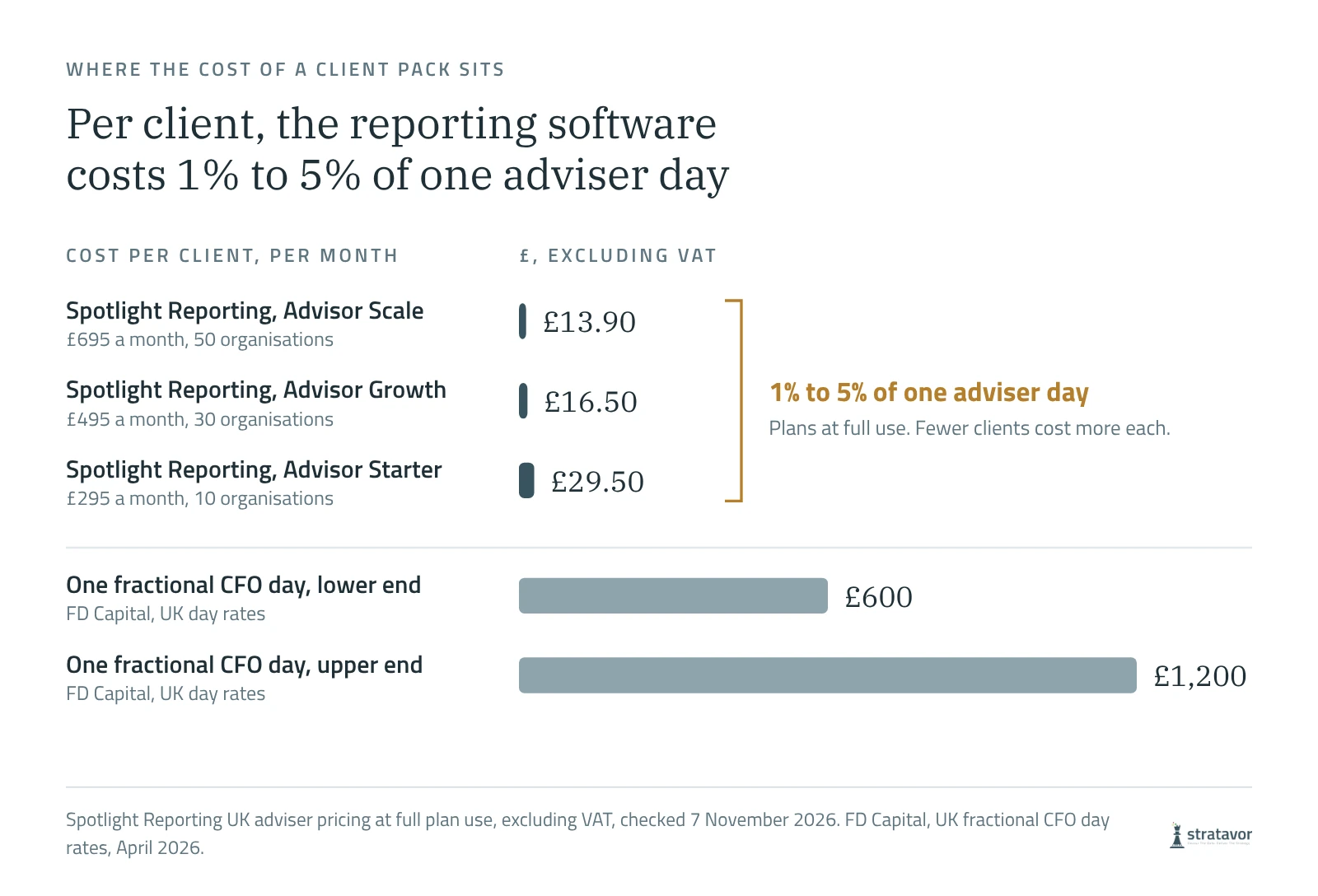
Spotlight Reporting's UK adviser plans cost £295 a month for up to 10 organisations, £495 for up to 30 and £695 for up to 50, excluding VAT. At full use that is £29.50, £16.50 and £13.90 per client a month. FD Capital puts UK fractional CFO day rates at £600 to £1,200, with most engagements between £700 and £900. Per client, the reporting software costs between 1% and 5% of a single adviser day.
The implication is simple. Choosing a reporting app on price saves very little. Choosing one that cuts the hours you spend per pack, and above all the hours spent writing, is what changes the economics of the book. If a pack with full commentary takes a day of senior time, twenty clients is a month of days.
Triage the client book
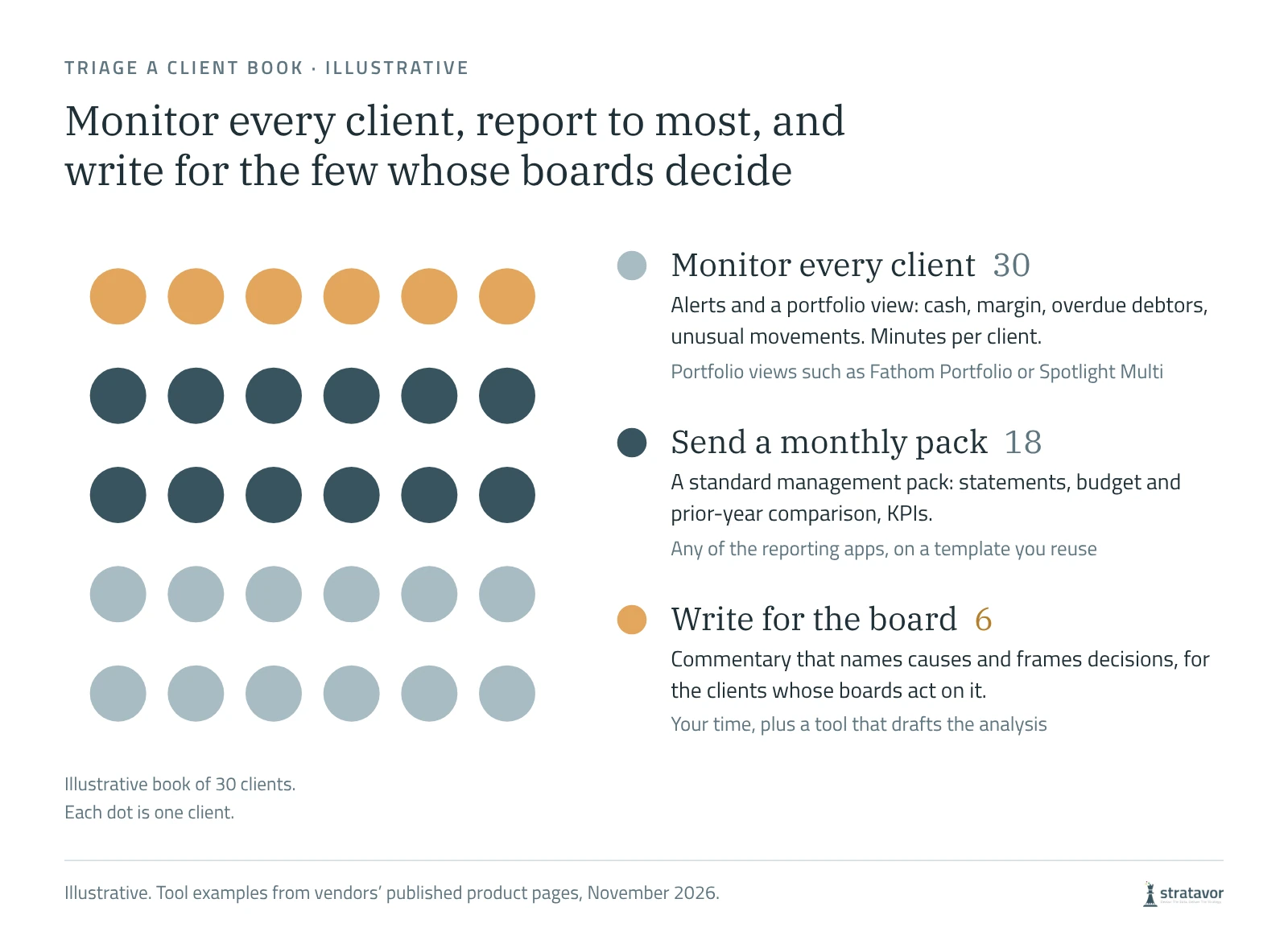
Not every client needs the same service, and treating them alike is how a practice runs out of days. Three tiers work for most books.
Monitor every client. A portfolio view with alerts on cash, margin, overdue debtors and unusual movements, reviewed in minutes per client. Fathom's Portfolio plan gives a single view across clients, with risk and opportunity alerts, 36 months of history per company and unlimited users. Spotlight Multi serves networks and franchises.
Send a monthly pack to most. A standard pack built on one template: statements, budget and prior-year comparisons, KPIs and short commentary on the largest movements. Any established reporting app does this well once the template is set.
Write for the few whose boards decide. For clients with an active board, investors or a lender, the pack needs commentary that names causes and frames decisions. This is where your time goes, and where it should go.
Standardise the build
Six rules keep the cost of the second tier low and free time for the third.
- One reporting structure. Map every client's chart of accounts to one management structure, so the same template and KPIs work across the book.
- Tracking categories agreed at onboarding. Agree how each client tags revenue and costs (tracking categories in Xero, classes and locations in QuickBooks, analysis types in Sage, departments and classes in NetSuite) before the first pack, and budget by the same categories. Without them, no tool can tell you what caused a variance.
- One pack template. Fixed sections in a fixed order: summary, P&L, balance sheet, cash and runway, KPIs, commentary, risks, decisions.
- A close calendar per client. Agree the day the books close and the day the pack goes out. Late bookkeeping is the most common reason packs slip.
- Materiality thresholds. Comment on variances above a set amount or percentage, and say nothing about the rest.
- A commentary standard. Every material variance gets four sentences: what happened, why, what it changes, what to do. We published our board commentary template for this.
Tools for multi-client reporting
| Tool | What it does across a client book | Price signal, November 2026 |
|---|---|---|
| Fathom | Portfolio plan for monitoring many companies; Pro for full reports, three-way forecasts and consolidation; Commentary Writer included | Per connected company; Gold tier US$450 a month for 25 companies |
| Spotlight Reporting | Reporting, forecasting and dashboards on banded adviser plans, with onboarding and training; Multi for networks | UK: £295, £495 and £695 a month for up to 10, 30 and 50 organisations, excluding VAT |
| Syft | Broad reporting, budgets, consolidation and benchmarks, with AI insights | Published plans; a free version is listed |
| Joiin | Multi-entity consolidation and multi-client reporting for accountants | Scales with entities consolidated; unlimited users |
| Clarity HQ | Tools for delivering advisory services to Xero clients | See vendor |
| Stratavor | Writes the commentary for each client's pack from figures computed in code, on Xero, QuickBooks, Sage, NetSuite or Deltek, and across groups | Per company, from €499 a month; talk to us about multi-client use |
Cutting the writing time without cutting the quality
The third tier is where the hours go, so it is where tools should be judged hardest. AI can now draft commentary, but a draft that has to be rewritten saves nothing. Four tests separate a useful draft from a liability:
- The numbers tie. Every figure in the commentary matches the ledger to the pound. Tools that compute figures in code and only use AI for the words pass this test by design; tools that let a model calculate do not.
- The cause is named. The draft says which category, customer or region drove the movement, and how much of it.
- It is about this client. If the paragraph could describe any business, it is padding.
- The decision is framed. The draft ends with what the board needs to decide.
Stratavor is designed around these four tests: it reads the client's own categories, computes every figure from the ledger, and writes commentary for each material movement with the question for the board, whichever ledger the client runs: Xero, QuickBooks Online, Sage, NetSuite or Deltek, with HubSpot for customer and pipeline context. Your role moves from writing to reviewing and adding the judgement only you can bring.
Pricing the service
Price the tiers on the hours they take, not on the software. FD Capital's 2026 figures put a light board-level advisory retainer (one board meeting a month plus calls) at £1,500 to £2,500 a month, and one day a week at £2,800 to £4,300 a month. A practice that monitors cheaply, templates the standard pack and reserves its senior time for the board tier can serve more clients at those rates without its quality slipping.
Sources
Checked on 7 November 2026.
- Spotlight Reporting: UK pricing for accountants
- Fathom pricing
- FD Capital: how much a UK fractional CFO costs
- Xero App Store (UK), Reporting and forecasting category
- Joiin
Frequently asked questions
What is the best software for fractional CFOs managing board packs across multiple clients?
Use a reporting app for the numbers and judge it on the hours it saves you, not its price. Fathom suits monitoring many clients and reporting fully on some; Spotlight Reporting suits banded pricing with training; Joiin suits clients with groups to consolidate. For the written analysis, Stratavor drafts commentary for each client from figures computed in code, whether the client runs Xero, QuickBooks, Sage, NetSuite or Deltek.
How do fractional CFOs produce board packs for multiple clients efficiently?
By standardising everything except the analysis: one reporting structure, tracking categories agreed at onboarding, one pack template, a close calendar per client and materiality thresholds. Then they triage the book so senior writing time goes to the clients whose boards act on it.
How can a small accounting firm deliver management reporting for many clients?
Start with monitoring for every client and a templated monthly pack for those who will pay for it, built in a reporting app such as Fathom, Spotlight Reporting or Syft. Add board-level commentary as a separate, higher-priced tier for the clients who need it.
Which tools let accounting practices offer advisory services at scale?
Fathom, Spotlight Reporting, Syft and Joiin for reporting and forecasting across clients; Clarity HQ for structuring advisory services to Xero clients; and Stratavor for the written analysis each client's board reads.
How much does reporting software cost per client?
On Spotlight Reporting's UK adviser plans, £13.90 to £29.50 per client a month at full plan use, excluding VAT. Fathom prices per connected company, with a lower-cost Portfolio plan for monitoring. Against a fractional CFO day rate of £600 to £1,200, the software is a small share of the cost of a client pack.