
Fathom vs Spotlight Reporting for Xero board packs, and the alternatives for board commentary
Jon Goodwin ·
Estimated reading time: 9 min
The short answer. Choose Fathom if you want KPI analysis, three-way forecasting and consolidation in one product, with its AI Commentary Writer included. Choose Spotlight Reporting if you run an advisory practice and want reporting, forecasting, dashboards and ESG reporting on a tiered plan priced by client organisations. Both are mature, with Xero App Store ratings of 4.95 and 4.86. If what the board needs is commentary that names the cause of each movement, judge any tool, these two included, on what it writes about your own variances.
Fathom and Spotlight Reporting are two of the most-reviewed apps in the reporting category of the Xero App Store, and both now ship AI writing features. When a finance lead or an accounting firm asks which to choose, they are usually asking two questions at once: which tool should build the reports, and who will write the commentary that goes with them. This guide answers both, with every fact checked against the vendors' own pages on 7 November 2026.
Fathom and Spotlight Reporting side by side
| Fathom | Spotlight Reporting | |
|---|---|---|
| Ownership | The Access Group, since August 2022; founded in Queensland, Australia | Spotlight Reporting, a New Zealand company |
| Core products | Management reporting, KPIs, three-way forecasting, budgets and scenarios, consolidation, benchmarking | Reporting, Forecasting, Dashboards, consolidation, Sustain for ESG; Multi sold separately |
| AI writing | Commentary Writer, launched March 2026, included at no extra cost | Spotlight AI drafts or enriches the executive summary; optional |
| Consolidation | Multi-currency, with eliminations | Up to 75 entities on adviser plans, all currencies |
| Accounting integrations | Xero, QuickBooks Online and Desktop, MYOB, FreeAgent, Excel, Google Sheets | Xero, QuickBooks |
| Pricing model | Per connected company, monthly, no contract | Tiered by client organisations, with plans for advisers and for finance teams |
| List prices, 7 November 2026 | Gold tier of Fathom Pro: US$450 a month for 25 companies | UK adviser plans: £295 (10 organisations), £495 (30), £695 (50), excluding VAT |
| Free trial | 14 days | 14 days, no card required |
| Xero App Store (UK) | 4.95 from 621 reviews | 4.86 from 341 reviews |
Where Fathom is stronger
Depth of analysis. Fathom's Pro plan includes custom KPIs and targets, benchmarking and ranking across clients, and chart of accounts customisation. For a finance lead who wants to interrogate the numbers before writing about them, it goes further.
Forecasting. Three-way cash flow forecasting, with budgets and scenarios, sits in the same product as the reports.
Integrations. Beyond Xero and QuickBooks Online, Fathom connects to QuickBooks Desktop, MYOB, FreeAgent and Google Sheets, and imports from Excel, so it can report on clients whose ledgers are elsewhere.
Monitoring a large client base. The Portfolio plan gives a single view across clients, with risk and opportunity alerts, 36 months of history per company and unlimited users, at a much lower cost per company than Pro. Firms can monitor everyone on Portfolio and upgrade the clients that need full reports.
Where Spotlight Reporting is stronger
Predictable pricing for a practice. UK adviser plans are priced in bands: £295 a month for up to 10 organisations, £495 for up to 30 and £695 for up to 50, excluding VAT. A firm with 25 clients knows its cost before it starts.
Support for building an advisory service. Plans include onboarding, certification and training, with a customer success manager from the Growth tier. That matters to firms building an advisory line for the first time.
ESG and networks. Sustain, for ESG reporting, is included from the Growth tier. Spotlight Multi serves franchises, networks and associations reporting across many entities.
How their AI commentary compares
Both vendors have added AI writing, and both keep a person in the loop.
Fathom's Commentary Writer analyses the P&L, balance sheet, KPIs, charts and custom tables in a report. You set business context once (goals, strategy, priorities, current challenges) and add notes for each period, such as a product launch or a hiring pause. Hovering over a figure in the commentary shows its source and how it was calculated. Fathom launched it in March 2026 and includes it at no extra cost.
Spotlight AI drafts an executive summary from the report and the topics you choose, or enriches a summary you have started with further insights, recommendations and next steps. Spotlight says it calculates the figures first and layers the AI on top, that the AI features are optional, and that the data they process is held in AWS's Sydney region and not used for training.
Both work from figures the tool has already computed, which is the right design. The difference that matters can only be tested on your own data: does the commentary name a cause, size it and say what it changes, or does it describe the movement in words?
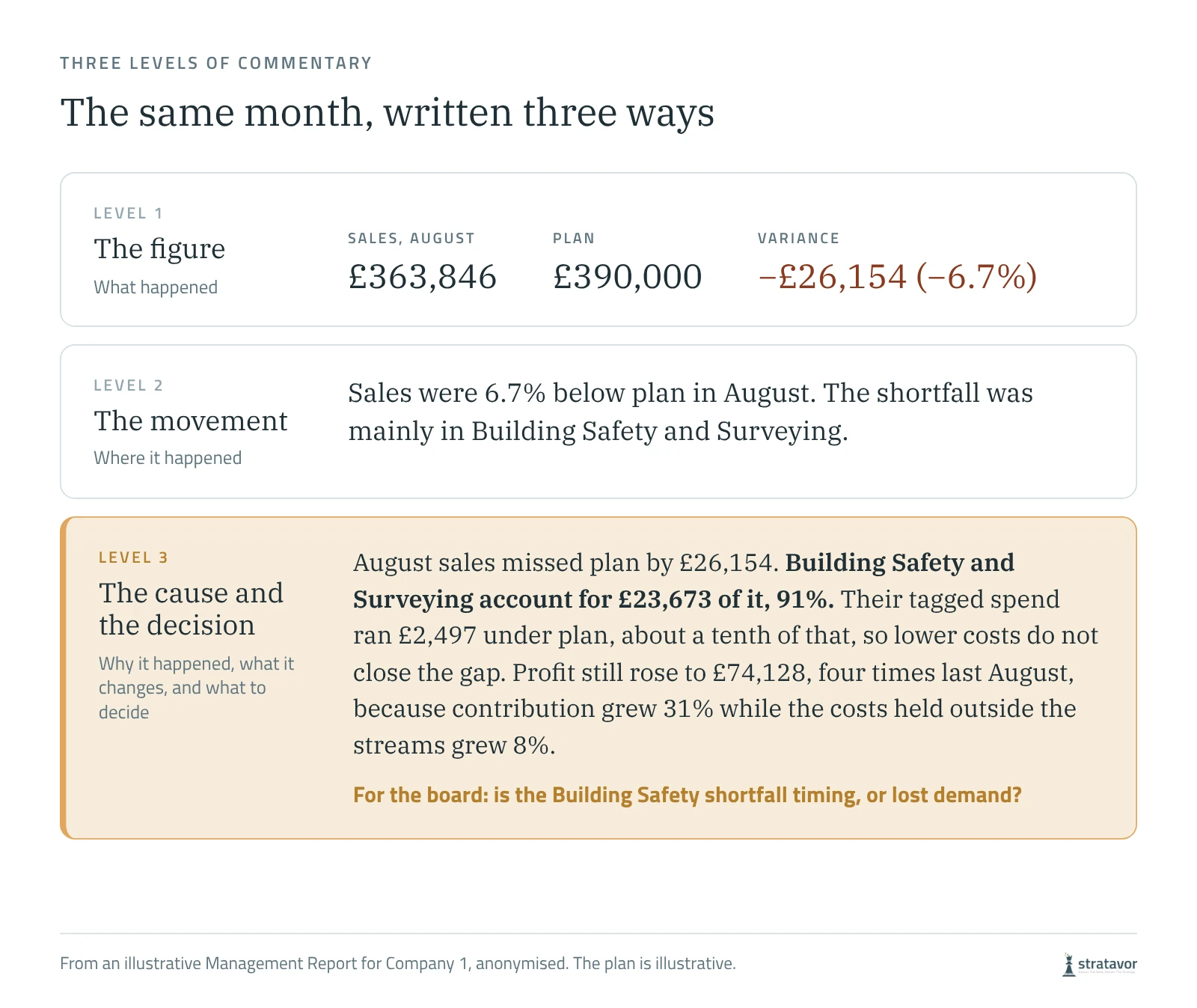
Level one is what a report shows. Level two is where much commentary stops: it says where the movement happened. Level three is what a board can act on. It names the cause, sizes it against the total, checks whether anything offsets it, connects it to profit, and ends with the question the board has to answer.
Level three depends less on the language model than on the data underneath it. The commentary can only name a cause if the variance has been cut by the categories the business budgets by. In Xero those are tracking categories; in QuickBooks, classes and locations.
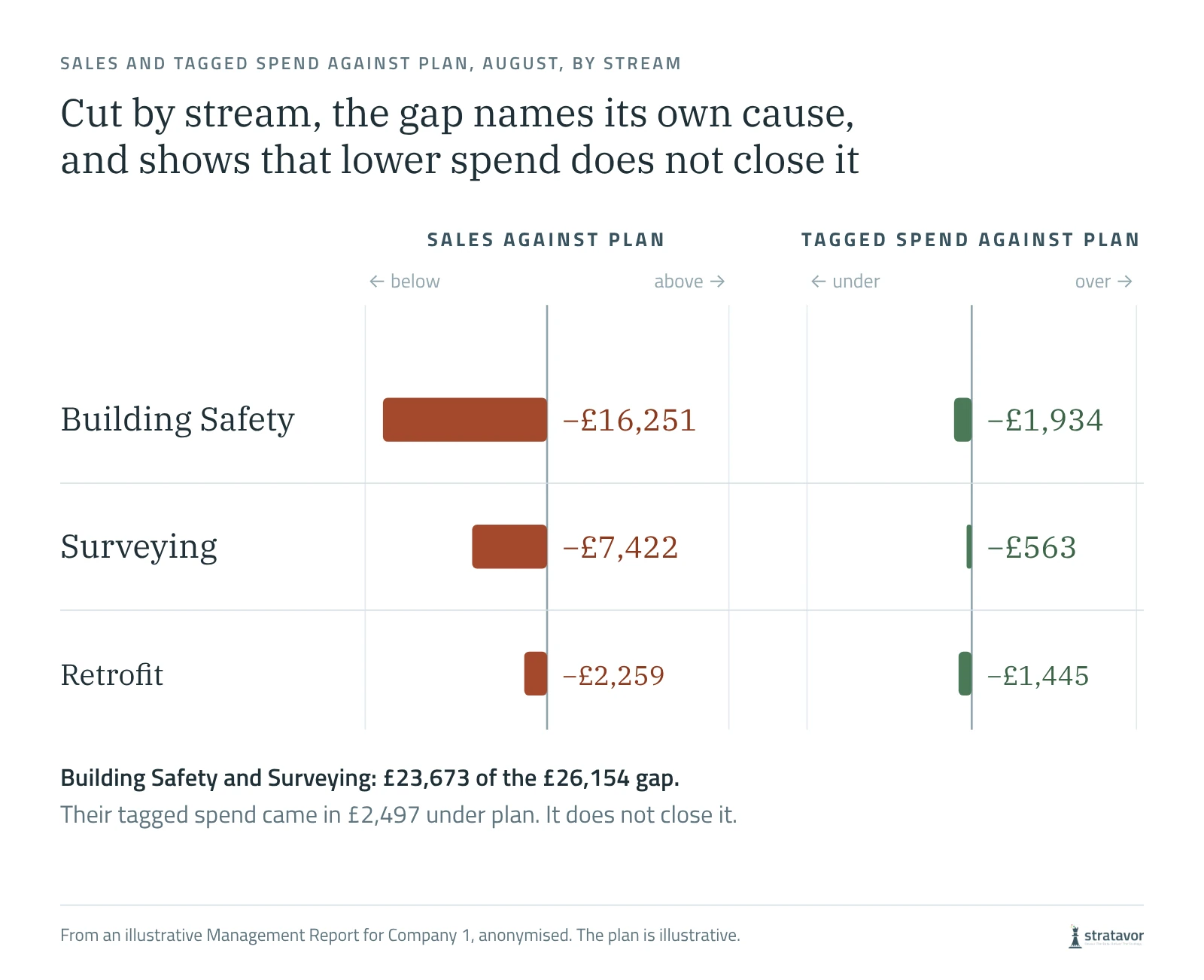
When you trial either tool, take your largest variance from last month and ask for commentary on it. Then check three things: whether it names the line that caused the variance, whether it says how much of the total that line explains, and whether it tells the board something it did not already know from the table.
The alternatives when the board needs commentary
If the reason you are comparing Fathom and Spotlight is that writing the board commentary takes too long, these are the alternatives worth a look.
Stratavor
Stratavor is built around the analysis rather than the report layout. It connects read-only to Xero, QuickBooks Online, Sage, NetSuite and Deltek Vantagepoint, with HubSpot for customer and pipeline context, computes every figure in code from the ledger, and writes commentary on each material movement: what changed, which category, customer or region caused it, what it means and what the board should decide. It reads the tracking categories you already keep, so budgets and variances use the same lines. The language model writes only around figures that have already been checked. From €499 a month, with a 7-day free trial.
It reports on single companies and across accounting groups. It is not a forecasting tool: because it connects to the same ledger read-only, you can keep Fathom or Spotlight Reporting for forecasts and use Stratavor for the written analysis.
Syft
Broad reporting, budgets, consolidation, valuations and benchmarks, with AI insights, at a low entry price. Syft is owned by Xero and remains available as a standalone product.
Joiin
The strongest choice when the pack has to consolidate several entities, with intercompany and currency handling, and plans that scale with the number of entities.
Datarails
Datarails suits a different buyer: a mid-market finance team that works in Excel and runs budgeting, close and reporting across several systems. Its plans (Professional, Premium and Expert) are quoted, scale with users and integrations, and include AI agents. Its AI Storyboards feature generates presentations from dashboards.
Board Intelligence
Board Intelligence helps executives write and review board papers, now through Report Writer, a Microsoft add-in. It is about the quality of the paper, not about producing the numbers from the ledger.
Datarails vs Fathom for automated financial narrative
The two are often compared, but they are built for different teams. Datarails is an Excel-native FP&A platform for finance teams consolidating data from several systems, with AI agents and AI Storyboards, priced by quote. Fathom is a reporting and forecasting app for businesses on Xero, QuickBooks, MYOB and similar ledgers, and their advisers, with Commentary Writer included and pricing by connected company. If your team lives in Excel and runs a full planning cycle across several systems, Datarails fits. If you run on Xero or QuickBooks, Fathom or Spotlight Reporting will be quicker to value. If the narrative itself is the gap, on Xero, QuickBooks, Sage, NetSuite or Deltek, Stratavor writes it from the ledger.
Which should you choose?
- You are an accounting firm building an advisory service across 10 to 50 clients: Spotlight Reporting, for banded pricing, training and support.
- You want the deepest analysis and forecasting for a single business or a small group: Fathom.
- You need to monitor a large client base cheaply and report fully on a few: Fathom, using Portfolio for most clients and Pro for the rest.
- Your bottleneck is writing commentary the board can act on: test Fathom's Commentary Writer and Spotlight AI on your own variances, and compare them with Stratavor.
- You consolidate several entities: Joiin, Fathom or Spotlight Reporting, with Stratavor if the group's board needs written commentary.
For the wider market, including Syft, Calxa, Futrli and Xero's own analytics, see our comparison of the best Xero reporting tools for board packs.
Sources
Checked on 7 November 2026. If anything here is out of date, tell us and we will correct it.
- Fathom pricing and 2026 price change
- Fathom: introducing Commentary Writer
- Accounting Today: Fathom acquired by The Access Group
- Spotlight Reporting: UK pricing for accountants and Spotlight AI
- Xero App Store (UK), Reporting and forecasting category
- Datarails cost and features
- Board Intelligence: Report Writer
Frequently asked questions
Is Fathom better than Spotlight Reporting?
Neither is better in general. Fathom is stronger on KPI analysis, three-way forecasting and the range of ledgers it connects to. Spotlight Reporting suits accounting firms that want banded pricing by client organisation, training and ESG reporting. Both are rated above 4.8 on the Xero App Store.
Which is cheaper, Fathom or Spotlight Reporting?
It depends on how many companies you report on. Spotlight's UK adviser plans cost £295, £495 and £695 a month for up to 10, 30 and 50 organisations, excluding VAT. Fathom prices by connected company; its Gold tier was US$450 a month for 25 companies on 7 November 2026, and its Portfolio plan costs far less per company for monitoring.
Do Fathom and Spotlight Reporting write board commentary?
Both have AI writing features. Fathom's Commentary Writer, included since March 2026, writes commentary on reports using business context you set and shows the source of each figure. Spotlight AI drafts or enriches the executive summary. Test both on your own largest variance and check whether the commentary names a cause.
What is the best alternative to Fathom for Xero management reporting?
For a similar reporting suite, Spotlight Reporting or Syft. For groups, Joiin. If the gap is the written analysis rather than the reports, Stratavor writes commentary on every material movement from figures computed in code, and can run alongside a reporting app.
Is Datarails or Fathom better for automated financial narrative?
They suit different teams. Datarails is an Excel-native FP&A platform for mid-market finance teams working across several systems, with AI Storyboards and quoted pricing. Fathom is a reporting app for businesses on Xero, QuickBooks and similar ledgers, with Commentary Writer included.
Can I use Stratavor with Fathom or Spotlight Reporting?
Yes. Stratavor connects read-only to the same ledger, whether that is Xero, QuickBooks, Sage, NetSuite or Deltek, so you can keep a reporting app for forecasting and use Stratavor for the written analysis.