
Management accounts with commentary for a £10m business: what to include, and a four-day route to the board
Jon Goodwin ·
Estimated reading time: 8 min
The short answer. For a business with around £10m turnover, monthly management accounts should be a short pack that leads with a one-page summary, then the P&L against budget and last year, the balance sheet, cash and runway, KPIs, commentary on each material variance, risks, and the decisions the board is asked to make. Good commentary names the cause of each movement and sizes it, using the same categories you budget by. With a clean close and tracking categories kept in Xero or QuickBooks, the whole pack can be built in four working days.
At £10m turnover a business has outgrown the year-end accounts and the bank balance as ways of knowing how it is doing, but rarely has a full finance team. The monthly management accounts are where the board, the lender and the owner learn what is happening. Most packs at this size have the numbers. What they lack is the explanation, and the explanation is what the board reads.
What to include
We recommend eight sections, in this order. Most £10m businesses can cover them in eight to twelve pages.
- One-page summary. The month and the year to date in five or six sentences: the result, the two or three movements that explain it, the cash position, and what the board needs to decide. Write it last, put it first.
- P&L against budget and last year. Revenue, gross margin and overheads by the lines you manage the business by, with the variance in money and in percent.
- Balance sheet. Working capital in particular: debtors and debtor days, creditors, stock, and anything unusual.
- Cash and runway. Opening and closing cash, the main movements, headroom against facilities and covenants, and runway on current trends. Our 13-week cash flow template covers the short-term view.
- KPIs against target. Six to ten measures the board has agreed, with the trend, not just the month.
- Commentary on material variances. For each variance above your threshold: what happened, why, what it changes, and what management is doing.
- Risks. The few risks that could move the forecast, each with a measure and the threshold that would trigger action.
- Decisions. What the board is asked to decide this month, with the options and a recommendation.
Commentary that names the cause
A variance is a total. Until it has been cut by the categories that make it up, it explains nothing. The rule is to keep cutting until a single line, customer or region accounts for most of it.
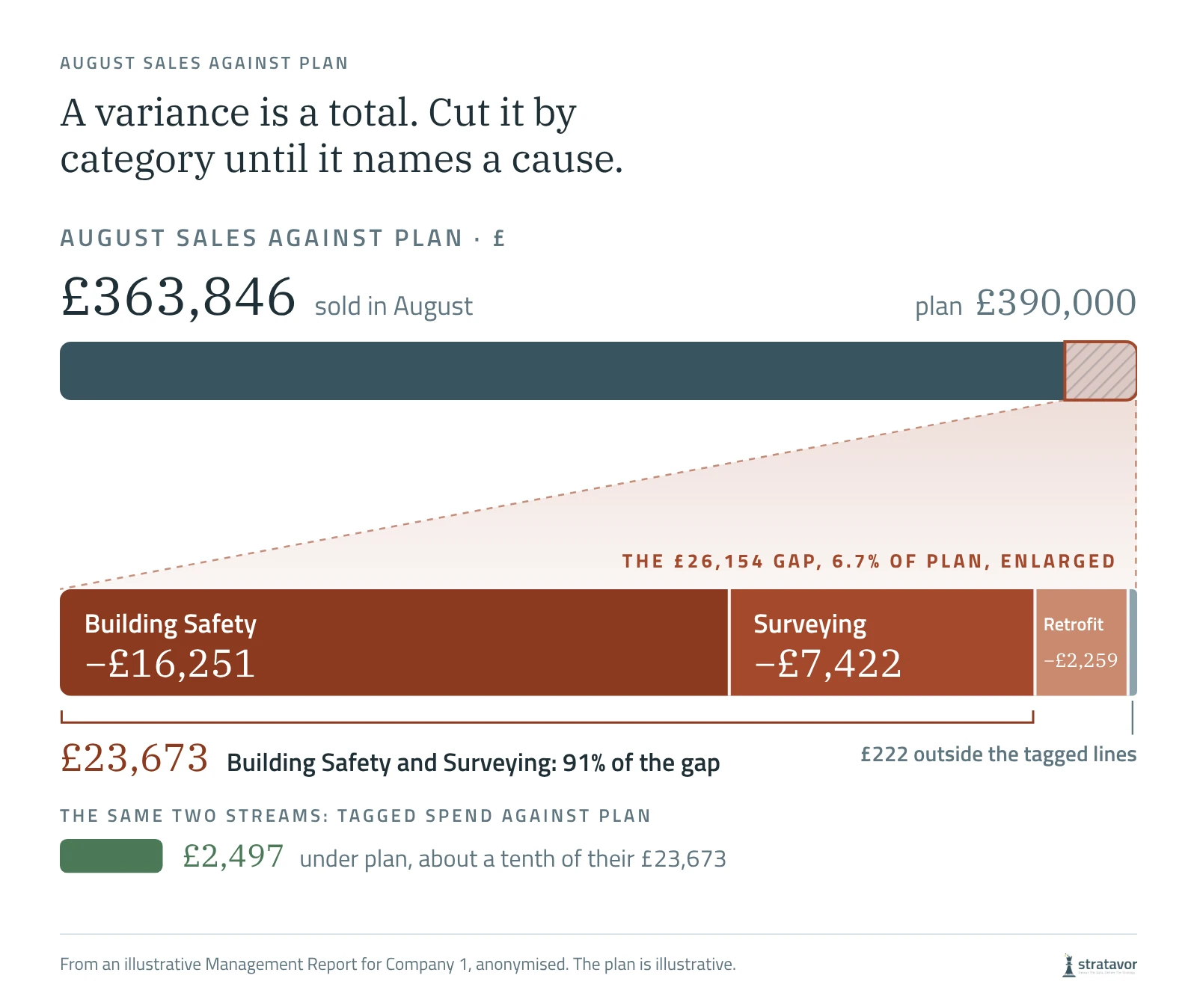
In this example the month's sales missed plan by £26,154, or 6.7%. Cut by stream, two lines explain 91% of it: Building Safety (£16,251) and Surveying (£7,422). The same two streams spent £2,497 less than planned, about a tenth of their shortfall, so lower costs do not close the gap. That is three sentences of commentary, each with one number, and the board now knows where to look.
Compare it with the commentary most packs carry: sales were below budget due to lower activity in the month. It is accurate and it is useless, because it could be written about any business in any month.
This only works if the ledger and the budget use the same categories. In Xero that means tracking categories, of which you can have two active at a time; in QuickBooks, classes and locations; in Sage, analysis types; in NetSuite, departments, classes and locations. Tag revenue and direct costs by the lines you manage, and set the budget by the same lines.
Show the mechanism behind profit
Profit is easier to explain when the pack shows how it is made. Split the P&L into the contribution each stream earns and the costs held outside the streams, such as central staff and premises. Net profit is the gap between the two.
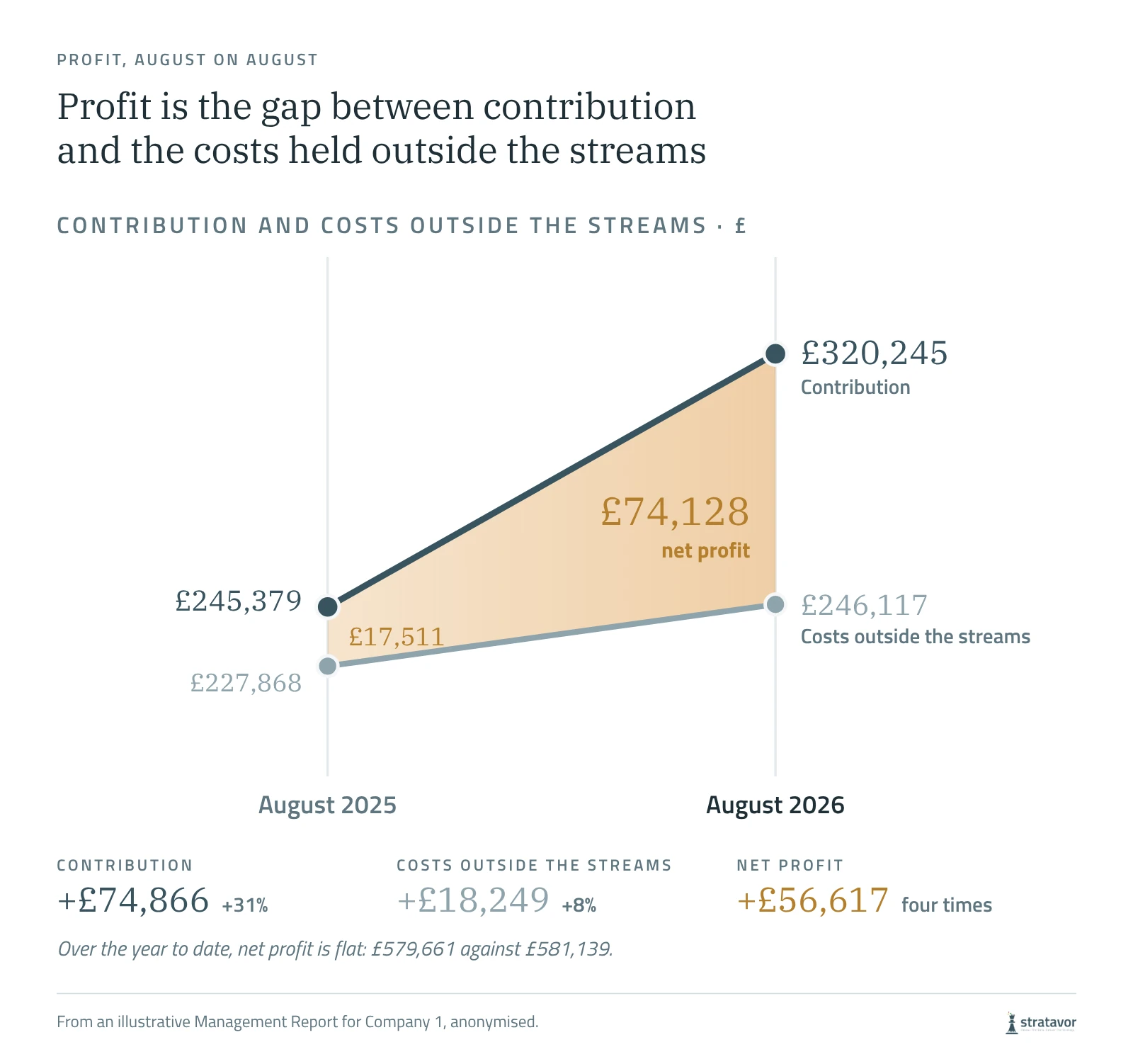
In the example, August profit rose to £74,128, four times the previous August, because contribution grew 31% while central costs grew 8%. Put another way, 23p of each pound of August contribution reached profit, against 7p a year earlier. The year to date tells a different story: profit is flat at £579,661 against £581,139. A board needs both sentences. The month shows the mechanism working; the year shows it has not yet changed the outcome.
A four-day route from month-end to the board
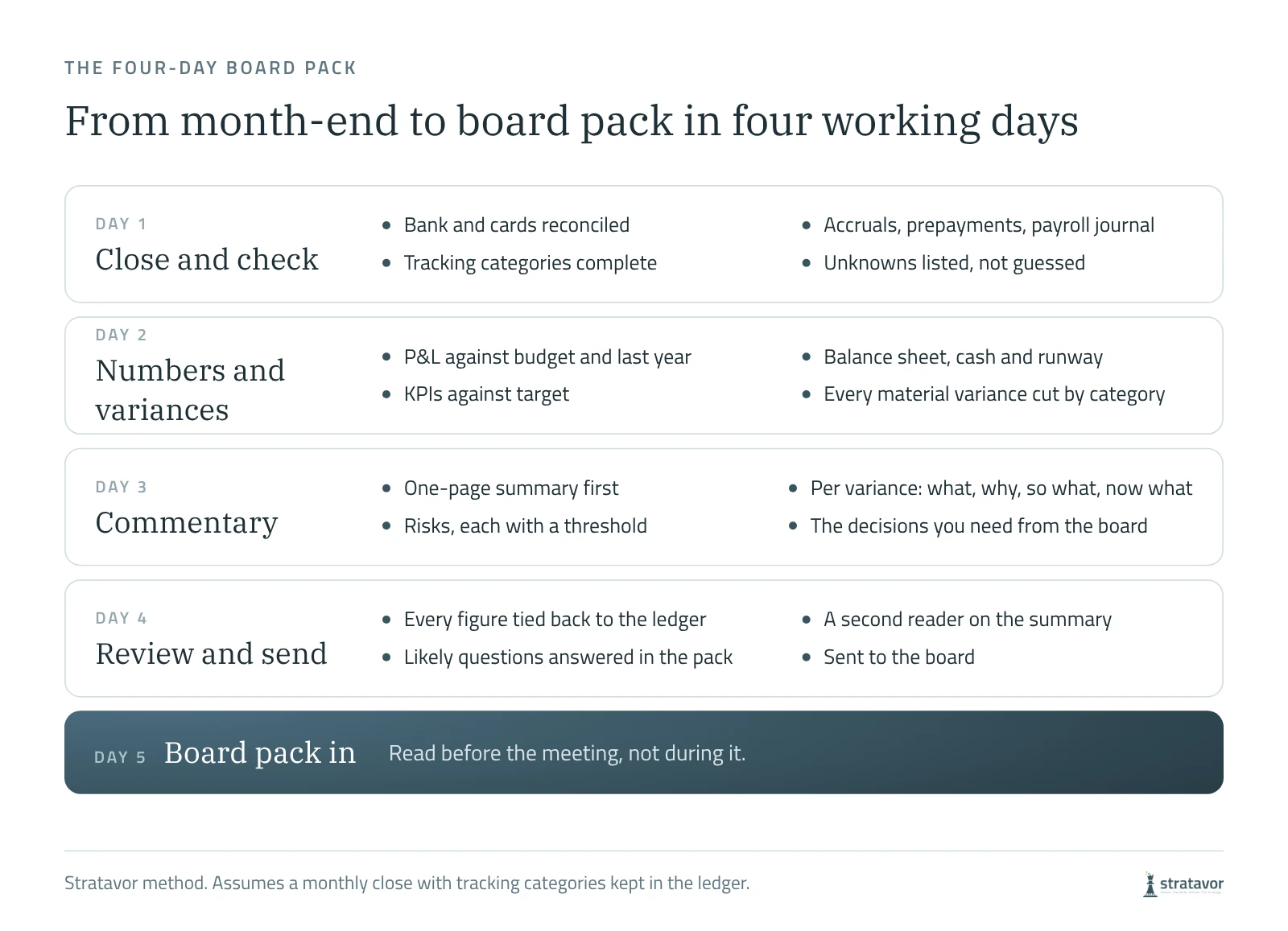
Day 1: close and check. Reconcile bank and card accounts, post accruals, prepayments and the payroll journal, and check that every revenue and direct cost line carries its tracking category. List anything unknown rather than guessing; an honest open item is better than a wrong number.
Day 2: numbers and variances. Run the P&L against budget and last year, the balance sheet, the cash position and runway, and the KPIs. Cut every variance above your threshold by category until each one names a cause.
Day 3: commentary. Write the one-page summary first as a draft, then the commentary for each material variance, then the risks and the decisions. Each variance gets four sentences: what happened, why, what it changes, what management is doing.
Day 4: review and send. Tie every figure in the commentary back to the ledger. Ask one person who did not write the pack to read the summary and say what they would ask. Answer that in the pack, then send it.
The board pack is due Friday and you are still in Excel
If the pack is due in days and the numbers are still being pulled from Xero into spreadsheets, cut scope rather than quality:
- Freeze the numbers by midday on the second day. No late journals unless they are material; note them as open items instead.
- Write the summary and the three largest variances properly. Skip commentary on everything else.
- Use last month's structure. This is not the week to redesign the pack.
- Send the summary to the chair a day early. It buys goodwill and surfaces the questions you will be asked.
- Fix the cause afterwards. If this happens every month, the problem is the close or the manual build, not the week.
Commentary that is not generic
Generic commentary is the most common complaint boards have about management accounts. Five rules fix most of it.
- Lead with the answer. The first sentence says what the month means, not what the revenue figure was.
- One number per sentence. Three numbers in a sentence means none of them registers.
- Name the line. A category, a customer, a region or a cost line, never the business in general.
- Say what it changes. For the forecast, the cash, the covenant or the plan.
- Ask for the decision. End with what the board should decide, or say that nothing needs deciding.
Our 12-paragraph board commentary framework sets out a full structure, and the board commentary template gives you a starting point.
Consultant-style narrative without the consultant
The structure behind a strong consulting paper is not secret. The Pyramid Principle, developed by Barbara Minto at McKinsey, puts the answer first and supports it with a small number of grouped arguments, each backed by evidence. Applied to management accounts: the summary is the answer, the material variances are the arguments, and the cut-down figures are the evidence. A finance team that writes in that order will produce a clearer pack than most consultants, because it has the data and the context.
Where software helps
Software helps most with day two and day three. Reporting apps such as Fathom, Spotlight Reporting and Syft build the statements, comparisons and KPIs. Stratavor goes a step further: it connects read-only to Xero, QuickBooks Online, Sage, NetSuite or Deltek Vantagepoint, with HubSpot for customer and pipeline context, computes every figure in code, cuts each material variance by your own categories, and drafts the commentary, the risks and the questions for the board, for a single company or across a group. The language model never calculates a figure; it writes only around numbers that already tie to the ledger. You review it, add what only you know, and send it.
For a comparison of the tools, see the best Xero reporting tools for board packs.
Frequently asked questions
What should management accounts include for a £10m business?
A one-page summary; the P&L against budget and last year; the balance sheet with working capital; cash, headroom and runway; KPIs against target; commentary on each material variance; the main risks with thresholds; and the decisions the board is asked to make. Eight to twelve pages is usually enough.
How do I produce management accounts with commentary for a £10m business?
Close the month with tracking categories complete, run the P&L, balance sheet, cash and KPIs against budget and last year, cut each material variance by category until it names a cause, and write four sentences per variance: what happened, why, what it changes and what to do. With a clean close this takes about four working days.
How long should a board pack be?
As short as the decisions allow. For a £10m business, eight to twelve pages of management accounts, led by a one-page summary, is usually enough. Detail the board does not need goes in an appendix.
How do finance teams turn Xero data into board commentary?
By tagging revenue and costs with tracking categories, budgeting by the same categories, and cutting each variance by them until a single line explains most of it. The commentary then names that line, sizes it and says what it changes. Tools such as Stratavor draft this commentary from Xero data, with every figure computed in code.
How do small finance teams produce board packs without enterprise software?
With a disciplined close, a fixed pack template, tracking categories in Xero or QuickBooks, and a reporting or commentary tool that connects to the ledger. Enterprise FP&A suites are built for several systems and large teams; a business on one ledger rarely needs one.
How can I make board commentary less generic?
Lead with the answer, use one number per sentence, name the specific line, customer or region, say what the movement changes, and end with the decision. If a sentence could describe any business, cut it.