Skip to content

Tools and templatesGuide

KPI Selection Guide

Which measures belong in a board pack, and how to choose the eight that lead to decisions. Sixteen measures, each with its formula, a worked example, how to set its level and when to use it.

What it includes

Twenty-two pages: the short answer, six rules for choosing, sixteen measures each on a page of its own with a formula, a worked example, how to set its level and what to watch for, starter sets for five kinds of business, and a scorecard of eight set out for a board.

Who it is for

Owners, managing directors, finance leads and boards of businesses with roughly €1m to €50m revenue, and the advisers who prepare their packs.

How to use it

Start from the questions your board asks, take the starter set nearest your business, and set a target, floor or limit for each measure before the year starts.

Which KPIs belong in a board pack?

Six to eight measures: one or two for each question the board asks, each against a level set in advance. Most boards of businesses with €1m to €50m of revenue ask the same six questions. Report every measure with its level, where it stands in words, which way it is heading and what the board is asked to decide.

  • Are we on plan?

    Whether the year is going the way the budget said.

    • Revenue against budget and last year
    • Operating profit against budget
  • How safe is the revenue?

    Whether customers stay, and how much rests on a few.

    • Gross revenue retention
    • Customer concentration
  • Do we make money on what we sell?

    Whether prices keep up with costs, and which lines earn.

    • Gross margin
    • Sales mix
    • Contribution by line
  • Will the cash be there?

    Whether profit is becoming cash, and how close the low point comes.

    • Cash conversion
    • Debtor days
    • Cash headroom
  • Can we carry what we owe?

    How far trading can fall before a lender's test fails.

    • Current ratio
    • Interest cover
    • Net debt to EBITDA
  • If you sell time, are the hours paying?

    Whether the time paid for is billed, at a rate that covers the costs.

    • Utilisation
    • Net multiplier
    • Lock-up

Moves before the result it affects, so it gives the board time to act.

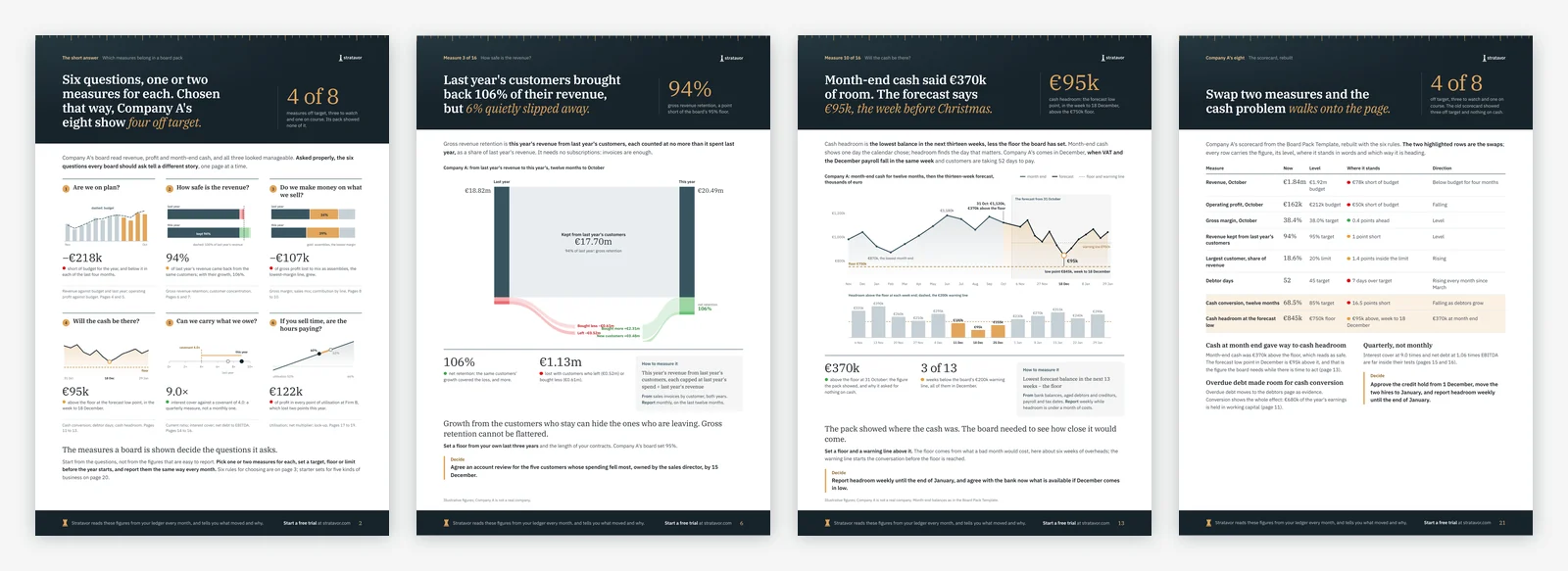
Four pages of the KPI selection guide: six questions answered with an illustrative company's figures, revenue retention drawn as a flow from last year to this year, cash headroom against the floor over thirteen weeks, and the company's eight measures with two swapped in.
Four of the twenty-two pages. Illustrative figures. Company A and Firm B are not real companies.

Sixteen measures, each with its formula

The guide gives each measure a page: the formula, where the figures come from, a worked example, how to set its level, what to watch for and the decision it asks for.

Revenue against budget and last yearAre we on plan?
Gap to budget = revenue − budget, in euro and as a share of budget. Growth = revenue ÷ revenue in the same period last year − 1.
Use it when. Always: every pack starts here. Pair it with retention, so the board can see whether growth comes from customers who stay or from replacing those who leave.
Operating profit against budgetAre we on plan?
Gap to budget = operating profit − budgeted operating profit, split into causes: volume (the revenue gap at the budgeted margin), margin (actual revenue × the change in margin) and each cost line that moved.
Use it when. Always. If your lender tests earnings before depreciation (EBITDA), show that too, and say which of the two the plan is measured on.
Gross revenue retentionHow safe is the revenue?
Gross revenue retention = this year's revenue from last year's customers, counting each at no more than it spent last year, ÷ last year's revenue. Net revenue retention also counts their growth.
Use it when. Any business that sells to the same customers more than once. It needs no subscriptions: invoices by customer are enough.
Customer concentrationHow safe is the revenue?
Largest customer's share = its revenue in the last twelve months ÷ total revenue; the top five likewise. Effective number of customers = 1 ÷ the sum of every customer's squared share.
Use it when. Any business where one customer, or one buyer behind several accounts, could change the year. Add supplier concentration when one supplier provides a third of purchases.
Gross marginDo we make money on what we sell?
Gross margin = (revenue − cost of sales) ÷ revenue.
Use it when. Any business that sells products or materials. Firms that sell time read the net multiplier instead.
Sales mixDo we make money on what we sell?
Mix effect = gross margin at last year's mix − gross margin at this year's mix, both at this year's margin for each line. Its cost = the mix effect × this year's revenue.
Use it when. Two or more lines whose margins differ by five points or more.
Contribution by lineDo we make money on what we sell?
Contribution = a line's gross profit − the costs tagged to it, such as its people, carriage and commission. Share reaching profit = operating profit ÷ total contribution.
Use it when. Two or more lines, sites or customer groups with costs of their own. Most accounting systems can tag costs by line with a tracking category or a class.
Cash conversionWill the cash be there?
Cash conversion = cash generated from operations ÷ EBITDA, over the last twelve months. Cash from operations = EBITDA − the increase in debtors and stock + the increase in creditors.
Use it when. Any business that holds stock or gives credit. It is often the first sign that reported profit and the bank balance are drifting apart.
Debtor daysWill the cash be there?
Debtor days = trade debtors ÷ revenue × 365, using the last three months' revenue at a yearly rate. Creditor days = trade creditors ÷ cost of sales × 365, on the same basis.
Use it when. Any business that invoices on credit. Add creditor days when suppliers fund a large part of working capital, and stock days when stock is more than a month of sales.
Cash headroomWill the cash be there?
Cash headroom = the lowest forecast balance in the next 13 weeks − the floor. If you have an undrawn overdraft or facility, add it and say so.
Use it when. Always, in place of month-end cash, once you keep a 13-week forecast. Report it weekly while headroom is less than a month of costs.
Current ratioCan we carry what we owe?
Current ratio = current assets ÷ current liabilities. The quick ratio leaves stock out of the assets.
Use it when. When a lender, a supplier's credit insurer or a tender asks for it, and quarterly if you borrow. Rarely a monthly board measure.
Interest coverCan we carry what we owe?
Interest cover = operating profit ÷ interest payable, over the last twelve months. Some facilities use EBITDA; use the definition in your facility letter.
Use it when. Any business with borrowing. Quarterly, on the dates the lender tests it, unless cover is close to the covenant.
Net debt to EBITDACan we carry what we owe?
Net debt to EBITDA = (borrowing − cash) ÷ EBITDA over the last twelve months.
Use it when. When you borrow, or plan to. Quarterly.
UtilisationIf you sell time, are the hours paying?
Utilisation = chargeable salary cost ÷ total salary cost, or chargeable hours ÷ hours available. One point is worth total salaries × 1% × the net multiplier.
Use it when. Any firm that sells time: accountants, engineers, architects, consultants and agencies.
Net multiplierIf you sell time, are the hours paying?
Net multiplier = net revenue ÷ direct labour, the salary cost of chargeable time. Break-even multiplier = 1 + overhead rate, where overhead rate = all other costs ÷ direct labour.
Use it when. With utilisation, in any firm that sells time.
Lock-upIf you sell time, are the hours paying?
Lock-up = work in progress days + debtor days. Work in progress days = unbilled work ÷ net revenue × 365.
Use it when. Any firm that sells time and bills after the work. It replaces debtor days on the scorecard.

This guide is the work done by hand. Stratavor does it from your ledger.

Every measure in the guide is arithmetic on a ledger. Stratavor is the strategic intelligence platform that does that arithmetic every month, for the people who run the business.

Your ledger and CRM

  1. It reads your systems

    Read-only connections to Xero, QuickBooks Online, Sage, NetSuite, Deltek Vantagepoint and HubSpot. Nothing is typed in.

  2. It finds what moved, and why

    Every measure is computed in code from the ledger, and each movement is traced to the customer, line or account behind it.

  3. It writes the page

    Each report opens with the answer and ends with what to decide, against the levels your board has set.

The page your board reads

7-day free trial. No credit card required.

Is the business on course, and will the cash be there?

Company A's eightCompany A, October 2026

Four measures are off target, three to watch and one on course

  • Revenue, October€1.84m€78k short of budget
  • Operating profit, October€162k€50k short of budget
  • Gross margin, October38.4%0.4 points ahead of target
  • Revenue kept from last year's customers94%1 point short of target
  • Largest customer, share of revenue18.6%1.4 points inside the limit
  • Debtor days527 days over target
  • Cash conversion, twelve months68.5%16.5 points short of target
  • Cash headroom at the forecast low€95kabove the floor, week to 18 December

To decide

Approve the credit hold from 1 December, move the two hires to January, and report headroom weekly until the end of January.

The scorecard the guide builds for Company A, kept current from the ledger. Illustrative figures. Company A is not a real company.

Frequently asked questions

Which KPIs belong in an SME board pack?

Six to eight measures, chosen from the questions the board asks: whether the business is on plan (revenue and operating profit against budget), how safe the revenue is (revenue retention and customer concentration), whether it makes money on what it sells (gross margin), whether the cash will be there (cash conversion, debtor days and cash headroom) and, for firms that sell time, whether the hours are paying (utilisation, net multiplier and lock-up). Each is reported against a target, floor or limit the board has set.

How many KPIs should a board see?

Six to eight, the same ones every month. Fewer leaves a question unanswered; more and the pack stops being read. Measures a lender tests quarterly, such as interest cover, are reported quarterly.

What is the difference between a target, a floor and a limit?

A target is where you plan to be, a floor is the least you will accept and a limit is the most. The board sets each one in advance, in the budget or the risk register, so that every figure can be read as on or off course.

Why measure cash headroom rather than cash at the month end?

Month-end cash says where you are. Headroom, the lowest balance in the next 13 weeks less the floor the board has set, says how close the coming months will come. In the guide's example, month-end cash is €370,000 above the floor and the low point in December is €95,000 above it.

Is the guide the same as Stratavor?

No. The guide explains how to choose the measures and work them out by hand. Stratavor is a strategic intelligence platform: it connects read-only to your accounting system and CRM, computes these measures in code from the ledger, sets each against the levels your board chooses and writes what changed, why it matters and what to decide. Every new account starts with a 7-day free trial.

Is the guide free?

Yes. Download the PDF and use it as you like; there is no sign-up.