Datarails alternatives for smaller finance teams
On this page
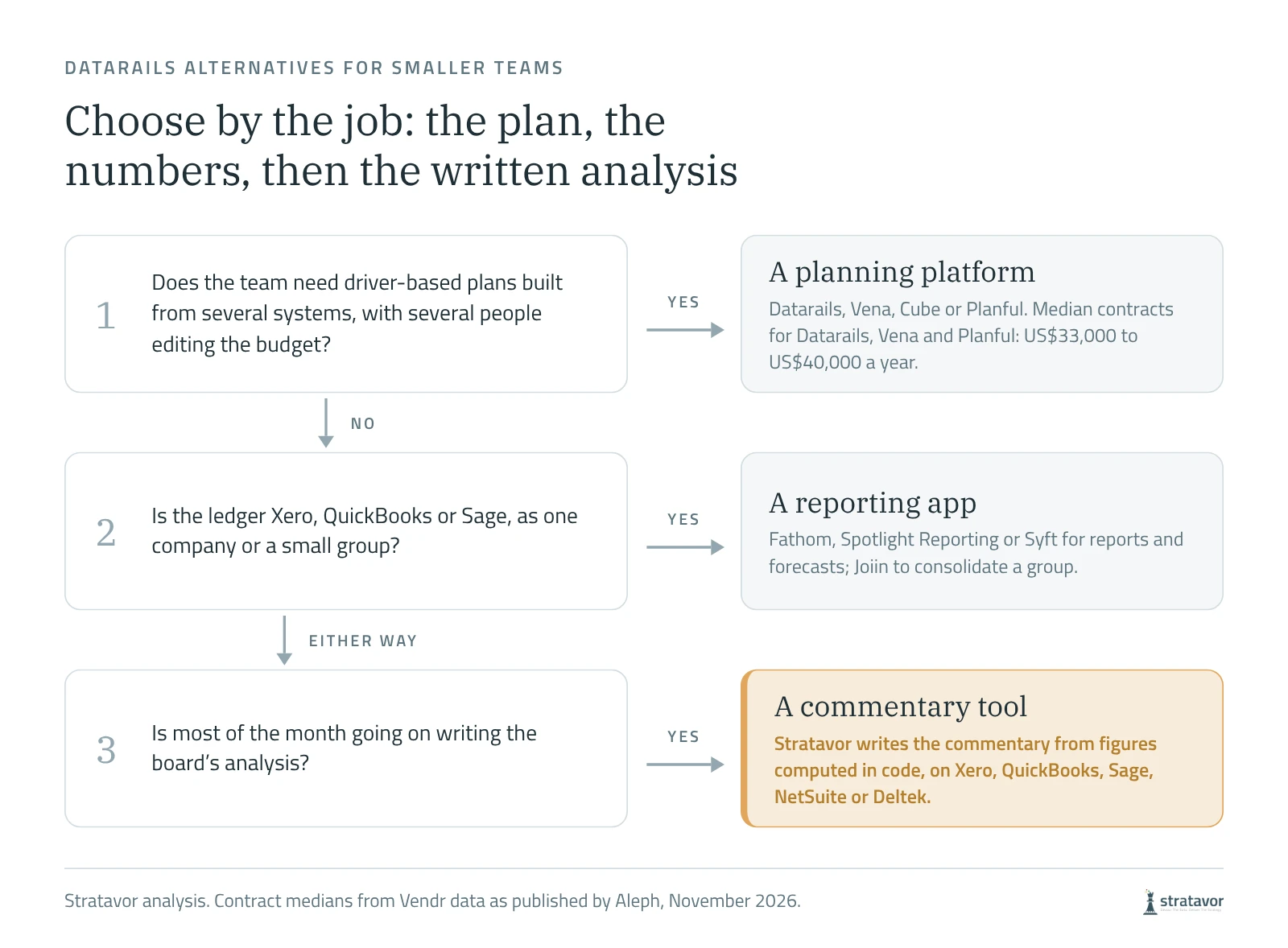
The short answer. Datarails is an Excel-native FP&A platform: it consolidates data from several systems, runs budgets and forecasts, builds reports and, with add-on modules, manages cash, the close and spend. Plans are quoted rather than published, and Vendr's transaction data puts the median annual contract at US$33,300. A smaller finance team should buy by the job. For planning across several systems, compare Datarails with Vena, Cube and Planful. For reports and forecasts on Xero, QuickBooks or Sage, a reporting app such as Fathom, Spotlight Reporting or Syft lists at a fraction of that. For consolidating a small group, Joiin. For the written board pack, Stratavor.
Datarails is built for finance teams that want to keep working in Excel while their numbers come from one governed source. For that job it is a strong fit. For a team of one to three people on a single ledger, it can be more platform than the job needs. This guide sets out what Datarails does and costs as of November 2026, how to tell whether you need a planning platform at all, and the alternatives by job.
What Datarails does, and what it costs
Datarails' own description, updated in October 2026, covers five jobs. It consolidates data from financial and operational sources into one governed source, with multiple charts of accounts, currency translation and intercompany eliminations. It builds budgets, forecasts and rolling models in Excel. It produces P&L, cash flow and KPI packs. It adds AI chat, automated agents for recurring analyses and custom agents that work on the governed data. And it sells cash, month-end close and spend as add-on modules.
Plans come in three tiers, priced by quote: Professional (two users, one integration), Premium (five users, two integrations) and Expert (fifteen users, fifty viewers, three integrations). Vendr's transaction data, as published in Aleph's November 2026 pricing guide, puts the median annual contract at US$33,300, close to Vena at US$34,286 and below Planful at US$40,352.
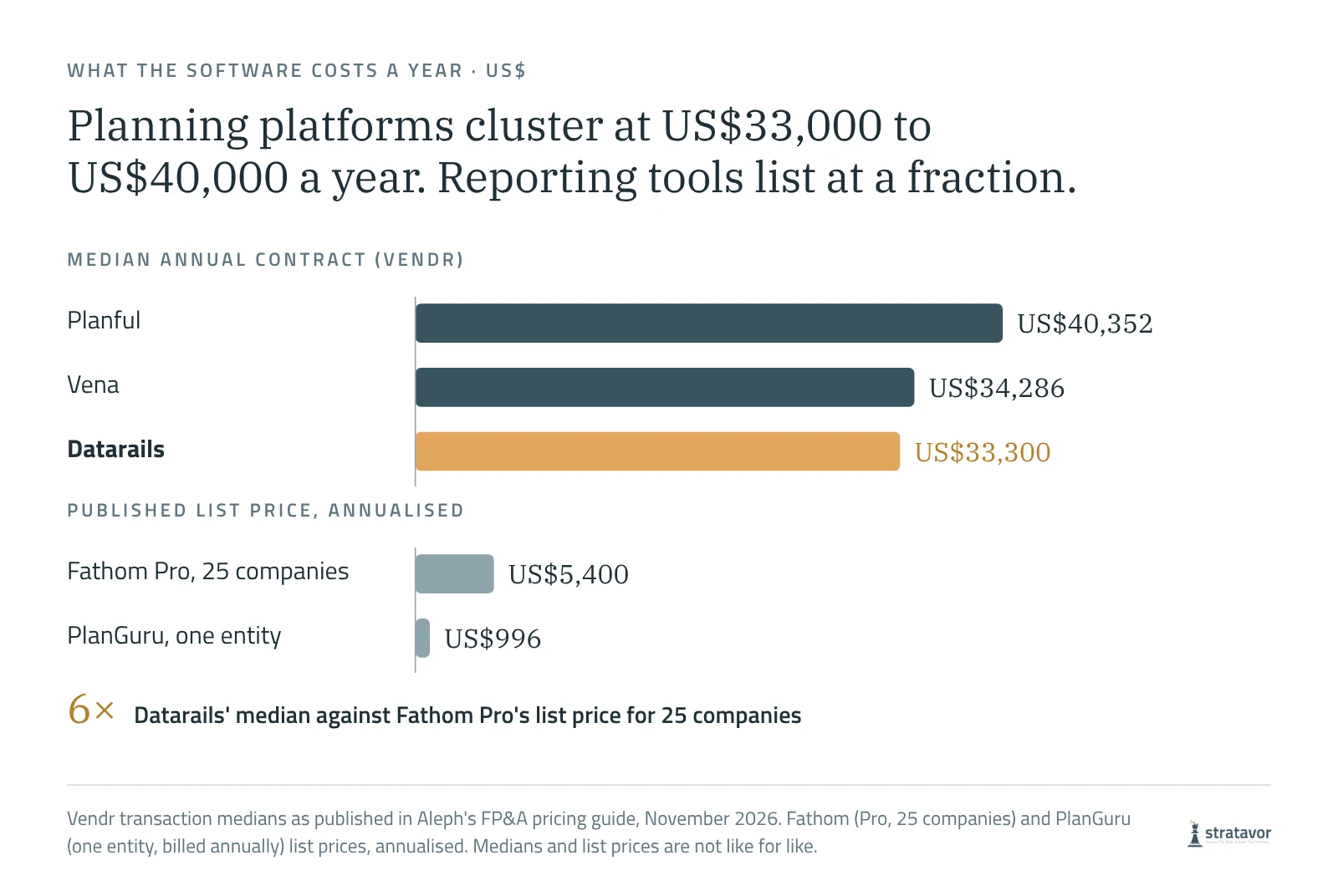
Planning platforms cluster at US$33,000 to US$40,000 a year. Reporting tools list at a fraction: Fathom Pro is US$450 a month for 25 companies, and PlanGuru, a budgeting tool for a single small business, lists at US$83 a month billed annually. A median contract and a list price measure different things, so the comparison is not like for like, but the order of magnitude is the point.
Do you need a planning platform at all?
A planning platform earns its cost when several of these are true:
- Data comes from several systems beyond the ledger, such as payroll, CRM and operations.
- Budgets are driver-based, with several people contributing and versions to control.
- Several entities need intercompany eliminations and currency translation every month.
- Investors or a lender review a rolling forecast every month.
If the business runs one ledger, sets the budget once a year and needs a monthly pack the board can act on, the time usually goes elsewhere: getting the numbers out, cutting the variances and writing the explanation. Buying a planning platform for that job pays for modelling the team will not use.
The alternatives, by job
| Tool | What it does | Suits a team that | Price signal, November 2026 |
|---|---|---|---|
| Vena | Excel-based planning for mid-market teams, with version control and actuals imported from the ERP | Plans in Excel across several systems | Median US$34,286 a year (Vendr) |
| Planful | Budgeting, forecasting and approval workflows | Runs a formal planning cycle | Median US$40,352 a year (Vendr) |
| Cube | Spreadsheet-native planning in Excel and Google Sheets | Wants planning without leaving its spreadsheets | Quoted |
| Jirav | Budgeting, forecasting and reporting for smaller businesses | Wants planning and reporting in one place | Rates for accounting firms from US$50 a month per client |
| PlanGuru | Budgets and forecasts for a single business | Needs a budget and a forecast, not a platform | From US$83 a month, billed annually |
| Fathom | Management reports, KPIs, three-way forecasts, consolidation and Commentary Writer on Xero, QuickBooks, Sage Accounting and others | Wants formatted reports and a forecast from its ledger | Pro US$450 a month for 25 companies |
| Spotlight Reporting | Reporting, forecasting and dashboards, with plans for accountants and advisers | Has an accountant or adviser who reports for it | UK adviser plans from £295 a month for up to 10 organisations |
| Syft | Reports, consolidation, budgets and forecasts | Wants reports and consolidation at low cost | Published plans; a free version is listed |
| Joiin | Consolidation and reporting across entities | Runs a small group on Xero or QuickBooks | Scales with the number of entities |
| Stratavor | Writes the board pack commentary from figures computed in code, on Xero, QuickBooks, Sage, NetSuite or Deltek, for single companies and groups | Spends its month writing the analysis | From €499 a month |
Vena, Cube and Planful are the like-for-like alternatives: each is a planning platform, and each asks the same questions of a team that Datarails does. The rest are cheaper because they do less, and for a smaller team that is often the right trade. Our guide to board reporting software covers the wider market.
Datarails alternatives for NetSuite teams
Datarails connects to NetSuite through saved searches, or through pre-built queries for the general ledger, trial balance and balance sheet. Three of the alternatives connect to NetSuite directly too: Vena through a direct integration that loads saved searches, Planful through NetSuite Connect, and Cube through the NetSuite API and saved searches. Fathom and Spotlight Reporting do not list NetSuite among their integrations, though both import from Excel. For the board pack itself, Stratavor connects read-only to NetSuite and writes the commentary from its data, alongside whichever planning platform the team uses. Our guide to board reporting software sets the NetSuite connections out side by side.
Commentary: Datarails AI, Fathom and Stratavor
For the written explanation of the month, the three take different routes. Datarails adds AI chat, agents for recurring analyses and custom agents on its governed data. Fathom's Commentary Writer drafts commentary inside its reports, with the numbers visible beside it. Stratavor computes every figure from the ledger in code first, then writes commentary on each material movement that names its cause and frames the board's question.
Whichever you use, judge the draft on four tests: the numbers tie to the ledger, the cause is named, the paragraph could only describe this business, and it ends with the decision. Our guide to board packs for many clients sets the tests out in full.
Where Stratavor fits
Stratavor is not a planning platform and is not a forecasting tool, so it does not replace Datarails for a team that needs a planning model. It replaces the part of the month spent writing the board pack. It connects to Xero, QuickBooks Online, Sage, NetSuite and Deltek Vantagepoint, with HubSpot for customer and pipeline context, reports on single companies and across groups, and the Power BI add-on carries the same figures and commentary into Power BI. A team that plans in Datarails, Vena or Cube can run Stratavor alongside it, from the same ledger, for the pack; a team that does not need a planning platform can pair it with a reporting app for the forecast. See pricing or talk to us.
Sources
Checked on 7 November 2026; the NetSuite connections on 14 November 2026.
- Datarails: cost and features
- Aleph: FP&A software pricing guide 2026
- Zone & Co: the 13 best NetSuite reporting tools, 29 October 2026
- Fathom pricing and Commentary Writer
- Spotlight Reporting: UK pricing for accountants
- Joiin
- NetSuite connections: Datarails, Vena, Planful and Cube; integrations listed by Fathom and Spotlight Reporting
Microsoft and Power BI are trademarks of the Microsoft group of companies.
Frequently asked questions
What is the best alternative to Datarails for a small finance team?
It depends on the job. For planning across several systems, Vena, Cube or Planful. For reports and forecasts on Xero, QuickBooks or Sage, a reporting app such as Fathom, Spotlight Reporting or Syft. For consolidating a small group, Joiin. For the written board pack, Stratavor, which works alongside any of them.
How much does Datarails cost?
Datarails quotes its plans rather than publishing prices. Its tiers run from Professional (two users, one integration) to Expert (fifteen users, fifty viewers, three integrations), with cash, close and spend as add-ons. Vendr's transaction data, as published by Aleph in November 2026, puts the median annual contract at US$33,300.
Is Datarails worth it for a small business?
It is worth it when the team plans in Excel across several systems, with several contributors and entities to consolidate. If the business runs one ledger and needs a monthly pack rather than a planning model, a reporting app and a commentary tool usually cost less and cover the job.
Datarails or Fathom for automated commentary?
Datarails offers AI chat and agents on its governed data; Fathom's Commentary Writer drafts commentary inside its reports. Judge either on whether the numbers tie to the ledger, the cause is named and the draft ends with the decision. Stratavor computes every figure in code before it writes, and names the cause of each material movement.
What are Excel-based alternatives to Datarails?
Vena is Excel-based planning for mid-market teams, and Cube works in Excel and Google Sheets. Vendr's median for Vena is US$34,286 a year; Cube quotes its prices.
What is the best Datarails alternative for a NetSuite team?
For a planning platform, Vena, Planful or Cube, each of which connects to NetSuite directly. For the written board pack on NetSuite data, Stratavor, which connects read-only and runs alongside a planning platform from the same ledger. Fathom and Spotlight Reporting do not list NetSuite among their integrations.
Does Stratavor replace Datarails?
No. Stratavor is not a planning or forecasting tool. It writes the board pack commentary from figures computed in code, on Xero, QuickBooks, Sage, NetSuite or Deltek, and can run alongside a planning platform from the same ledger.
The Stratavor digest
One email a month. Worth opening.
Decoded films on real companies' results, short films on how businesses make and lose money, and guides on customers, competitors, risk, cash and the board pack. No sales emails.
By subscribing you agree to receive the monthly Stratavor digest. Unsubscribe at any time from any email. Privacy policy.