
Board reporting software in 2026: portals, reporting apps, FP&A suites and commentary tools
Jon Goodwin ·
Estimated reading time: 8 min
The short answer. Board reporting software comes in four kinds. Board portals such as Diligent and BoardPro run the meeting: agendas, papers, minutes and votes. Reporting apps such as Fathom, Spotlight Reporting, Syft and Joiin, and FP&A suites such as Datarails, Cube, Vena and Planful, produce the numbers. Commentary tools such as Stratavor write the analysis of what moved and why. Most mid-market companies need one tool for the numbers and a reliable way to produce the analysis; a portal matters once the board wants one secure place for its papers.
Search for board reporting software and you will find all four kinds described in the same words. They are not substitutes. A board portal will not tell you why gross margin fell, and an FP&A suite will not take the minutes. Choosing well starts with knowing which part of the board pack is costing you the time.
A board pack is three jobs
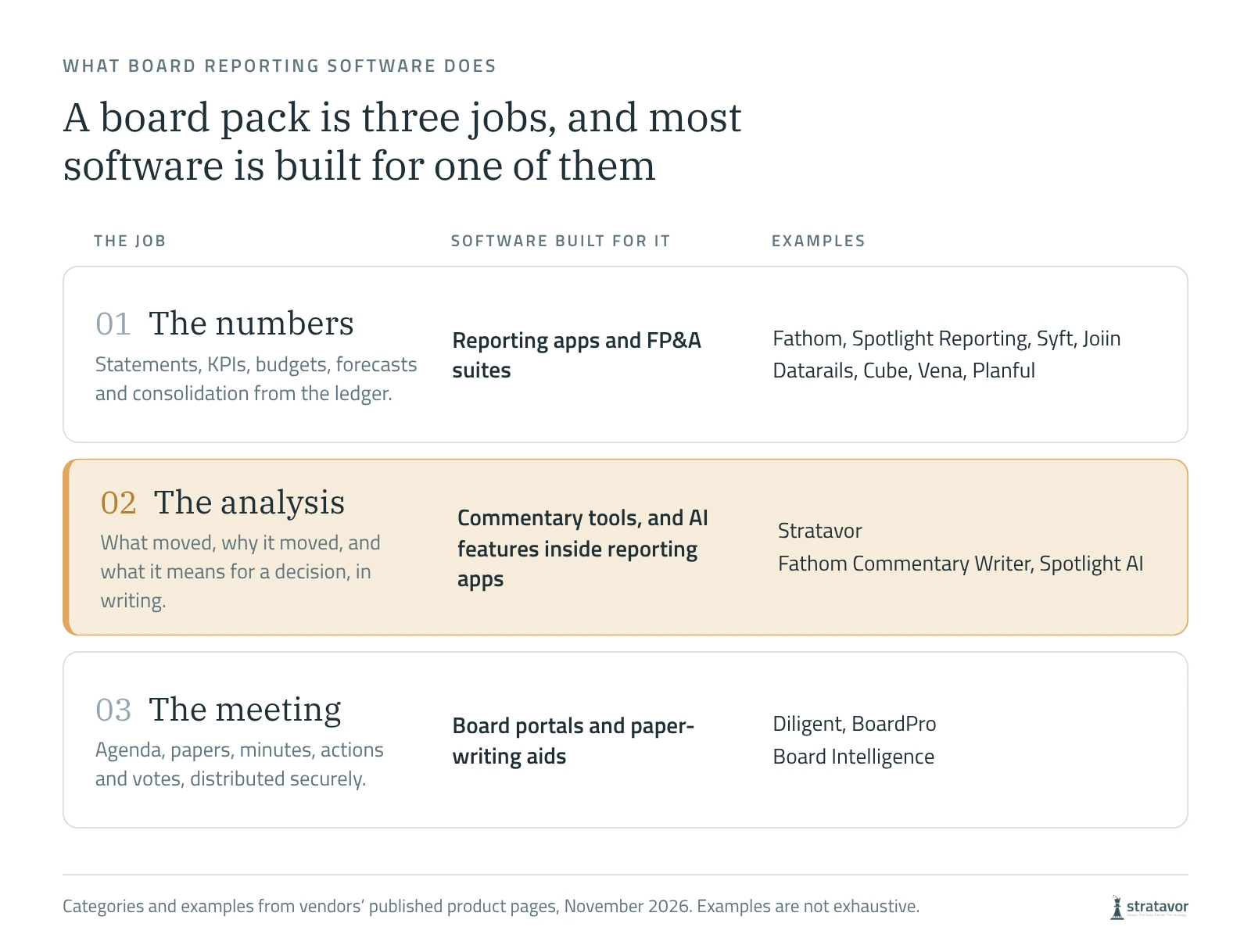
The numbers. Statements, KPIs, budget and prior-year comparisons, forecasts and, for groups, consolidation. This is the most automated part of the pack.
The analysis. What moved, why it moved, what it means for the plan and what the board should decide. This is the part a board reads first and the part most finance teams still write by hand.
The meeting. The agenda, the papers, the minutes, the actions and the votes, distributed securely to directors.
The four kinds compared
| Kind | What it automates | Examples | Usually bought by | Pricing signal, November 2026 |
|---|---|---|---|---|
| Board portals | Agendas, board packs as documents, minutes, actions, votes and signatures | Diligent, BoardPro | Company secretary or chair | BoardPro UK: £150 to £375 per board a month |
| Board paper writing aids | Drafting and reviewing papers | Board Intelligence, through Report Writer, a Microsoft add-in | Executives who write papers | On request |
| Reporting apps | Statements, KPIs, forecasts and consolidation from Xero, QuickBooks and similar ledgers | Fathom, Spotlight Reporting, Syft, Joiin | Finance teams and their advisers | Spotlight UK adviser plans £295 to £695 a month; Fathom priced per company |
| FP&A suites | Budgeting, forecasting, close and reporting across several systems | Datarails, Cube, Vena, Planful, Anaplan | Mid-market and enterprise finance teams | Mostly quoted; Datarails plans scale with users and integrations |
| Commentary tools | Written analysis of each material movement, from the ledger or ERP | Stratavor; AI features in Fathom and Spotlight | CFOs, finance directors and fractional CFOs | Stratavor from €499 a month |
Board portals
A board portal is where the board meeting lives. BoardPro's UK plans, for example, include an agenda builder, board packs, minutes, actions, a decision register and an interest register on every tier, with voting, annotations and electronic signatures from the middle tier. Pricing is per board: £150, £240 or £375 a month, with unlimited users and a 30-day free trial. Diligent is a widely used portal among larger organisations.
A portal assembles and distributes the pack. It does not produce the financial content. If your problem is that papers arrive late, in five formats, by email, a portal fixes it. If your problem is that the finance section takes a week to write, it will not.
Reporting apps
Reporting apps connect to an accounting ledger and produce formatted management reports, KPIs, forecasts and, in most cases, consolidation. Fathom, Spotlight Reporting, Syft and Joiin are among the most-reviewed general reporting apps on the Xero App Store, each rated between 4.81 and 4.95. Most now include an AI writing feature: Fathom's Commentary Writer, launched in March 2026, and Spotlight AI, which drafts the executive summary.
These are the right tools when the business runs on Xero, QuickBooks or a similar ledger and the board pack is mainly a set of reports. We compare them in detail in the best Xero reporting tools for board packs and in Fathom vs Spotlight Reporting.
FP&A suites, and board packs from ERP data
FP&A suites sit above one or more ERPs and run budgeting, forecasting, close and reporting for the finance team. Datarails is Excel-native, with plans that scale with users and integrations, AI agents, and AI Storyboards that generate presentations from dashboards. Vena is built around Excel and the Microsoft stack. Cube supports Excel and Google Sheets. Planful combines planning with close management. Anaplan bought Fluence Technologies in May 2024, which adds financial consolidation and close to its planning platform.
If the company's ledger is an ERP such as NetSuite, Microsoft Dynamics or Sage Intacct, and the finance team wants a full planning cycle across several systems, an FP&A suite is the usual route. Expect a quoted price and an implementation project measured in weeks or months, not days.
If what the board needs is the pack and its commentary rather than a planning cycle, there is a shorter route. Stratavor connects directly to NetSuite, Sage and Deltek Vantagepoint, the ERP common in architecture, engineering and consulting firms, as well as Xero and QuickBooks Online, and produces the board pack from that data without an FP&A implementation.
Commentary tools
The analysis is the slowest part of a board pack because it cannot be templated: every month the causes are different. Commentary tools address that part directly. Stratavor connects read-only to Xero, QuickBooks Online, Sage, NetSuite and Deltek Vantagepoint, with HubSpot for customer and pipeline context. It computes every figure in code, then writes commentary on each material movement: what changed, what caused it, what it means and what the board should decide. It reads the categories the business already keeps in its ledger, so a variance is explained in the same lines it was budgeted in, for a single company or across an accounting group. For teams that already report in Power BI, an add-on puts the same figures and commentary there.
The design matters. Language models are unreliable at arithmetic, so a tool that lets a model calculate the numbers will eventually put a wrong figure in front of a board. The safe pattern is to compute deterministically and let the model write only around checked figures. We set out why in why ChatGPT finance workflows keep breaking.
Automating a recurring board pack
For a monthly or quarterly board, automation pays off in the parts that repeat:
- Fix the structure. The same sections in the same order every period, so directors know where to look and the build can be templated.
- Set materiality thresholds. Decide which variances get commentary (for example, above a fixed amount or a percentage of the line) so the pack explains what matters and skips what does not.
- Budget by the categories you report by. Variances can only name a cause if the budget uses the same tracking categories, classes or departments as the ledger.
- Carry a decisions log. List what the board decided last time and what has happened since. It turns the pack from a report into a record of management.
- Keep the forward view in every pack. Cash runway, the forecast and the risks, each with a trigger, not only the month just closed.
Why board packs miss forward-looking insight
Most board packs are built from the ledger, and the ledger records what has already happened. Unless someone deliberately adds a forward view, the pack describes last month in detail and says little about the next six. The fix is structural: every pack should carry the cash runway on current trends, the forecast against the plan, the leading indicators that move first (pipeline, orders, debtor days), and the risks that would change the plan, each with a threshold that triggers action. We cover this in what your board pack is missing and in runway maths that survives a board meeting.
How to choose
Answer five questions before you book a demo:
- Which part of the pack takes the time? Assembling and distributing it points to a portal; building the numbers points to a reporting app or FP&A suite; writing the analysis points to a commentary tool.
- What is the ledger? Xero or QuickBooks points to reporting apps and commentary tools; an ERP with several systems points to an FP&A suite.
- Is there a group to consolidate? If so, check consolidation and intercompany handling before anything else.
- Who will maintain it? A suite needs an owner in the finance team. A reporting app or commentary tool should run on a small team.
- What does the board actually read? Ask the chair. Most read the summary and the commentary first.
Sources
Checked on 7 November 2026.
- BoardPro UK pricing
- Diligent: what is a board portal
- Board Intelligence: Report Writer
- Xero App Store (UK), Reporting and forecasting category
- Fathom: introducing Commentary Writer
- Spotlight Reporting: Spotlight AI and UK pricing
- Datarails cost and features
- element61: Anaplan Financial Consolidation, formerly Fluence Technologies
Microsoft and Power BI are trademarks of the Microsoft group of companies.
Frequently asked questions
What is board reporting software?
Software that automates part of producing a board pack. It comes in four kinds: board portals that run the meeting, reporting apps and FP&A suites that produce the numbers, and commentary tools that write the analysis. Few products do all of it, so most companies combine two.
What is the difference between a board portal and board reporting software?
A board portal such as Diligent or BoardPro distributes the pack and runs the meeting: agendas, papers, minutes, actions and votes. Board reporting software in the financial sense produces the content of the finance section: the numbers, the comparisons and the commentary.
What are the best automated board reporting tools for mid-market CFOs?
It depends on the ledger and the bottleneck. On Xero or QuickBooks, Fathom, Spotlight Reporting, Syft or Joiin produce the reports, and Stratavor writes the commentary. For a full planning cycle across several systems, an FP&A suite such as Datarails, Vena, Cube or Planful is the usual route; for the board pack and its commentary on NetSuite, Sage or Deltek, Stratavor connects directly. Add a portal such as Diligent or BoardPro when the board needs one place for its papers.
Which tools automate board-ready packs from existing finance systems?
Reporting apps automate packs from Xero, QuickBooks, MYOB and similar ledgers. FP&A suites automate packs from ERPs and several systems at once. Commentary tools such as Stratavor add the written analysis on top of Xero, QuickBooks, Sage, NetSuite or Deltek without replacing the systems you already run.
Which tools generate board packs from ERP data?
FP&A suites such as Datarails, Vena, Planful and Anaplan, which typically connect to ERPs such as NetSuite and Microsoft Dynamics, are usually quoted and implemented as a project. Stratavor connects directly to NetSuite, Sage and Deltek Vantagepoint, as well as Xero, QuickBooks Online and HubSpot, and produces the board pack and its commentary from that data.
Why do board packs often miss forward-looking insight?
Because they are built from the ledger, which records the past. A forward view has to be added on purpose: the cash runway, the forecast against plan, leading indicators and the risks that would change the plan, each with a threshold that triggers action.