Board packs for Irish SMEs: management reporting from Sage, Xero and QuickBooks
On this page
The short answer. An Irish SME's board pack needs the profit and loss against budget and last year, the balance sheet, cash with what is owed to Revenue on its own lines, six to eight KPIs, commentary on every material movement and the decisions the board is asked to make. Sage, Xero and QuickBooks all produce the statements. What makes a variance explainable is tagging: analysis types in Sage Accounting, departments and projects in Sage 50, analysis codes in Sage 200, dimensions in Sage Intacct, tracking categories in Xero, classes and locations in QuickBooks. Budget by the same tags, cut every material variance by them, and write four sentences per variance. Stratavor, built in Limerick, reads those tags in Sage, Xero or QuickBooks and drafts the commentary on each material movement from figures computed in code.
Ireland had 400,424 small and medium enterprises in 2023. They made up 99.8% of enterprises and accounted for 66.9% of persons employed, according to the CSO's Business in Ireland figures published in December 2025. Few of them need a board portal or a planning suite. They need a monthly pack that a board, a lender or an investor can read in ten minutes and act on. This guide sets out what that pack should hold, how to get it out of Sage, Xero or QuickBooks, and how to explain a variance in four sentences.
Who counts as an SME in Ireland
Since 1 July 2024, under S.I. No. 301 of 2024, a small company is one that does not exceed two of three limits: €15 million turnover, a €7.5 million balance sheet and 50 employees. A medium company stays within €50 million, €25 million and 250 employees. The limits apply to financial years beginning on or after 1 January 2024. Small companies can qualify for audit exemption, and for a company that takes it, the monthly pack is the board's main view of the numbers between one set of annual accounts and the next.
What the pack should contain
- Summary and decisions. One paragraph on the month, then the decisions the board is asked to make.
- Profit and loss. The month and the year to date against budget and last year, cut by the tags you keep.
- Balance sheet. With debtor and creditor days and the movement in net debt.
- Cash. The bank position and the next thirteen weeks of dated receipts and payments, with VAT and payroll taxes owed to Revenue on their own lines.
- KPIs. Six to eight measures the board chose, each against its target.
- Commentary. Four sentences for each material variance: what happened, why, what it changes and what to do.
- Risks. What could move the numbers next month, each with an owner.
Revenue's standard VAT period is two months, and the return is due by the 19th of the following month, or the 23rd through ROS. A bank balance looks healthiest in the weeks before a VAT payment, so a cash page that shows the amount and the date stops a board reading money it owes as money it has.
The KPIs that belong in an SME board pack
| KPI | How it is calculated | What the board reads from it |
|---|---|---|
| Gross margin | Gross profit divided by sales | Whether pricing and mix are holding |
| EBITDA | Operating profit before depreciation and amortisation | What trading generates before financing and tax |
| Debtor days | Trade debtors divided by sales, times 365 | How long customers take to pay |
| Creditor days | Trade creditors divided by cost of sales, times 365 | How long the business takes to pay suppliers |
| Cash headroom | The lowest balance in the thirteen-week view, less the reserve the board agreed | Room to absorb a bad month |
| Net debt to EBITDA | Borrowings less cash, divided by EBITDA | How a lender sees the business |
| Current ratio | Current assets divided by current liabilities | Short-term liquidity |
| Sales per employee | Sales divided by average headcount | Productivity as the team grows |
Pick the six to eight that match how the business makes money, fix the definitions, and print them on the KPI page so they cannot drift from month to month. Professional services firms add their own measures, which our guide to the nine numbers that matter for professional services firms covers.
Sage, product by product
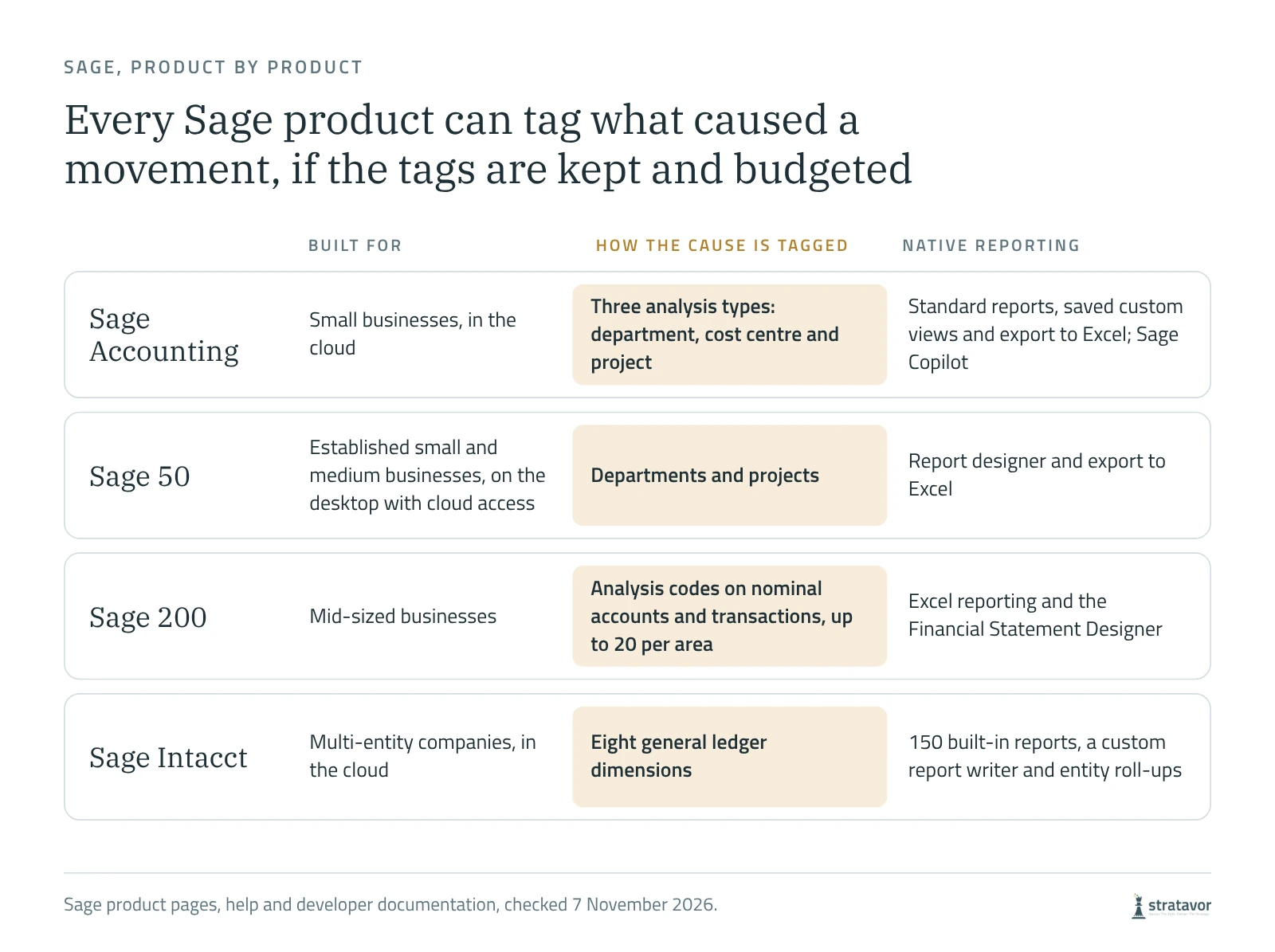
Every Sage product produces the statements. What differs is how transactions are tagged, and that decides whether a variance can be explained.
Sage Accounting tailors and saves report views and exports them to Excel, CSV and PDF. On the Accounting and Accounting Plus tiers it adds three transaction analysis types, by default department, cost centre and project.
Sage 50 records departments and projects, and its Report Designer builds custom reports that export to Excel.
Sage 200 adds analysis codes to nominal accounts and transactions, up to 20 per area with unlimited values, and runs financial reports in Excel from layouts set in its Financial Statement Designer.
Sage Intacct carries eight general ledger dimensions, 150 built-in financial reports and a custom report writer, and rolls figures up across entities.
Sage Copilot, launched for UK small businesses in 2025, is expanding across Sage Accounting, Sage 50 and Sage Intacct, and Sage said in April 2026 that an Intacct Finance Intelligence Agent would reach general availability later in the year. These help the finance team ask questions of the ledger. Writing the board's analysis is still a separate job.
Explain a variance: price, volume, mix and cost
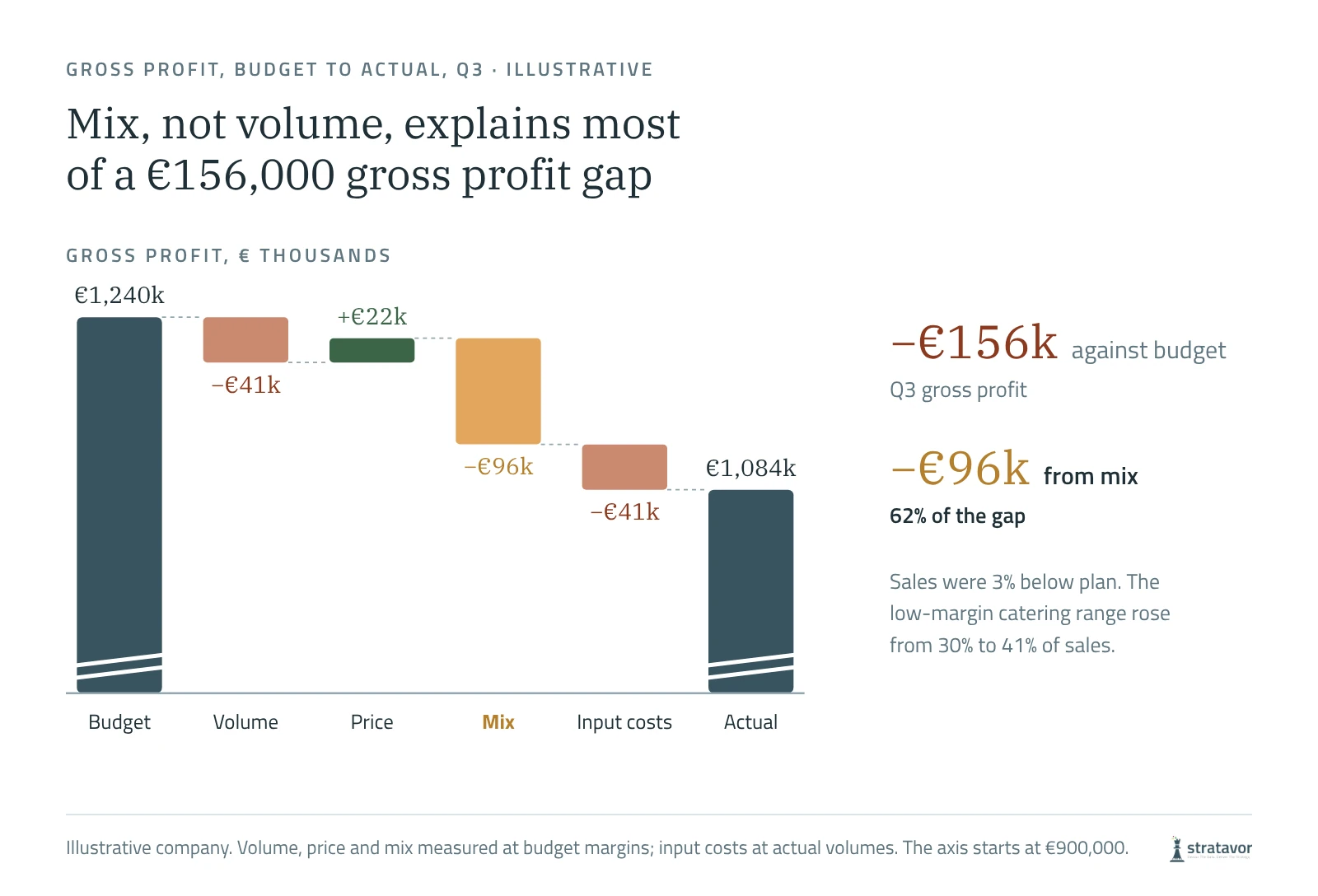
Boards ask the same question of any margin movement: was it price, volume, mix or cost? A bridge from budget to actual answers it in one picture. In the illustrative company, gross profit for the quarter is €156,000 below budget. Sales were 3% below plan, which cost €41,000, and price rises recovered €22,000. The larger effect is mix: the low-margin catering range rose from 30% to 41% of sales, which cost €96,000, or 62% of the gap. Input costs took a further €41,000.
The same quarter, written for the board in four sentences:
Illustrative. Q3 gross profit was €1,084,000, €156,000 below budget. Most of the gap is mix rather than volume: the lower-margin catering range rose from 30% to 41% of sales and cost €96,000, while lower volumes and higher input costs took €82,000 and price rises recovered €22,000. If the mix holds, it costs about €96,000 a quarter. The board is asked whether to reprice the catering range or steer sales back to the retail lines.
A bridge needs the categories in the ledger and the budget set by the same categories. Our board commentary template sets out the four-sentence standard.
Tools that sit on Sage, Xero and QuickBooks
| Tool | Works with | What it adds | Price signal, November 2026 |
|---|---|---|---|
| Sage's own reporting | Sage Accounting, Sage 50, Sage 200, Sage Intacct | Statements, tagged reports and Excel export | Included |
| Fathom | Xero, QuickBooks, Sage Accounting and others; listed on Sage's Irish marketplace | Management reports, KPIs, three-way forecasts, consolidation and Commentary Writer | Pro US$450 a month for 25 companies |
| Xero's own reporting | Xero | Statements, budget against actual by tracking category, dashboards and analytics; in Ireland, budgets start on the Standard plan | Part of the Xero plan |
| Syft | Xero, QuickBooks, Sage Accounting, Sage Intacct and others | Reports, consolidation, budgets and forecasts | Published plans; a free version is listed |
| Spotlight Reporting | Xero, QuickBooks, MYOB, Sage 50 and Sumday, with Excel imports | Reporting, forecasting and dashboards, consolidation across entities and currencies, and Spotlight AI for the executive summary | UK adviser plans from £295 a month for up to 10 organisations |
| Joiin | Xero, QuickBooks Online, Sage Accounting and others | Consolidation and reporting across entities, with eliminations and multiple reporting currencies | Priced by the number of companies consolidated, from US$28 a month |
| AccountsIQ | Its own cloud ledger, for UK and Irish groups | Multi-entity consolidation, intercompany and multi-currency | See vendor |
| Stratavor | Sage, Xero, QuickBooks Online, NetSuite and Deltek Vantagepoint, with HubSpot | Commentary on every material movement, naming the cause and framing the board's question; group reporting | From €499 a month |
Choose by the ledger first, because not every tool reads every Sage product. Spotlight Reporting lists Sage 50 among its imports; Fathom, Syft and Joiin list Sage Accounting, and Syft Sage Intacct too. A reporting app suits a company that wants formatted reports and a three-way forecast from its ledger. For a group, Joiin consolidates companies on different ledgers, and AccountsIQ does it inside its own. If the numbers are ready but the pack still takes days to write, the gap is the analysis.
Where Stratavor fits
Stratavor is built in Limerick. It connects to Sage, Xero and QuickBooks Online, as well as NetSuite and Deltek Vantagepoint, with HubSpot for customer and pipeline context. It reads the tags you already keep, computes every figure from the ledger in code, and writes commentary on each material movement that names its cause and frames the question for the board. It reports on single companies and across groups, and the Power BI add-on carries the same figures and commentary into Power BI. It is not a forecasting tool; if the board wants a three-way forecast, pair it with Fathom or Syft. See the integrations or talk to us about your Sage setup.
Sources
Checked on 7 November 2026; the Xero, Spotlight Reporting and Joiin rows on 14 November 2026.
- CSO: Business in Ireland 2023, key findings, 15 December 2025
- Chartered Accountants Ireland: company law thresholds
- Revenue: when VAT becomes payable
- Sage: Sage Accounting reporting, Ireland and analysis types
- Sage community: Sage 50 Report Designer and departments and projects
- Sage 200 help: analysis codes and Excel reports
- Sage: Intacct financial reporting and dashboards, Ireland
- Sage: Sage Copilot for small businesses, 27 January 2025 and AI agents, 28 April 2026
- Fathom: Sage integration and pricing
- Syft: Sage Accounting UK integration
- AccountsIQ: financial consolidation
- Xero Ireland: pricing plans
- Spotlight Reporting: consolidated reporting and UK pricing for accountants
- Joiin: integrations and pricing
Microsoft and Power BI are trademarks of the Microsoft group of companies.
Frequently asked questions
Which KPIs belong in an SME board pack?
Six to eight that match how the business makes money. Most packs need gross margin, EBITDA, debtor days, creditor days and cash headroom; a company with borrowing adds net debt to EBITDA and the current ratio, and a growing team adds sales per employee. Fix the definitions and show each against its target.
How do I explain a budget variance to the board?
Cut it until one cause explains most of it: first by the tags you keep, then by price, volume, mix and cost. Then write four sentences: what happened, why, what it changes and what the board should decide. In the example above, a €156,000 gross profit gap became one decision about one product range.
How can I automate commentary on management accounts?
Tag transactions and set the budget by the same tags, so software can cut each variance to its cause. Fathom's Commentary Writer drafts commentary inside its reports. Stratavor computes every figure from the ledger in code and writes commentary on each material movement for companies on Sage, Xero, QuickBooks, NetSuite or Deltek. Review the draft before it reaches the board.
What are the best board reporting tools for Irish SMEs on Sage or Xero?
It depends on the ledger and the job. Fathom, Syft and Spotlight Reporting produce formatted reports and forecasts; check which Sage product each reads, as Spotlight Reporting lists Sage 50 and the others list Sage Accounting. Joiin consolidates a group across ledgers, AccountsIQ consolidates inside its own ledger, and Stratavor writes the commentary on each material movement from Sage, Xero or QuickBooks data.
What reporting does Sage offer for management accounts?
Sage Accounting tailors and exports standard reports and tags transactions with analysis types. Sage 50 records departments and projects and has a Report Designer. Sage 200 adds analysis codes and Excel reporting. Sage Intacct has eight dimensions, 150 built-in reports and a report writer. All of them produce the statements; the board's written analysis is a separate job.
What counts as a small company in Ireland?
Since 1 July 2024, a company that does not exceed two of three limits: €15 million turnover, a €7.5 million balance sheet and 50 employees, under S.I. No. 301 of 2024. A medium company stays within €50 million, €25 million and 250 employees.
Does Stratavor work with Sage?
Yes. Stratavor connects to Sage as well as Xero, QuickBooks Online, NetSuite and Deltek Vantagepoint, with HubSpot for pipeline context, and writes the board pack commentary from figures computed in code, for single companies and across groups.
The Stratavor digest
One email a month. Worth opening.
Decoded films on real companies' results, short films on how businesses make and lose money, and guides on customers, competitors, risk, cash and the board pack. No sales emails.
By subscribing you agree to receive the monthly Stratavor digest. Unsubscribe at any time from any email. Privacy policy.