How to turn budget variance into board decisions
On this page
- From variance to decision in five steps
- Step 1: report only what is material
- Step 2: cut the variance down to its cause
- Step 3: sort each cause
- Step 4: roll it forward
- Step 5: frame the decision
- Where each type goes in the pack
- Keep a decision log, and report back
- Four mistakes that stop a variance becoming a decision
- Where Stratavor fits
- Sources
- Frequently asked questions
The short answer. A budget variance becomes a board decision in five steps. Report only the variances above a set threshold. Cut each one down to its cause. Sort each cause into timing, one-off or structural. Roll the structural ones forward to show what they cost over the rest of the year. Then put a decision in front of the board for each one: the options in money, a recommendation, an owner and a date. Timing and one-off variances are for noting; structural ones are for deciding. Stratavor connects read-only to Xero, QuickBooks Online, Sage, NetSuite and Deltek Vantagepoint, computes every variance in code, names its cause and drafts the question for the board.
Most variance reports stop one step short. They say what moved, sometimes why, and leave the board to work out whether anything needs to be done. Directors notice. In the research published with the 2026 update of Effective Board Reporting, by Board Intelligence and the Chartered Governance Institute UK & Ireland, 54% of respondents said they struggle to find the key messages in their board pack, and 47% said papers do not say enough about what the information implies.
A variance matters to a board only for what it changes. This guide sets out how to get from the number to the decision, with a worked example in which every figure ties. It picks up where our guide to writing variance commentary ends: at the sentence that asks the board to do something.
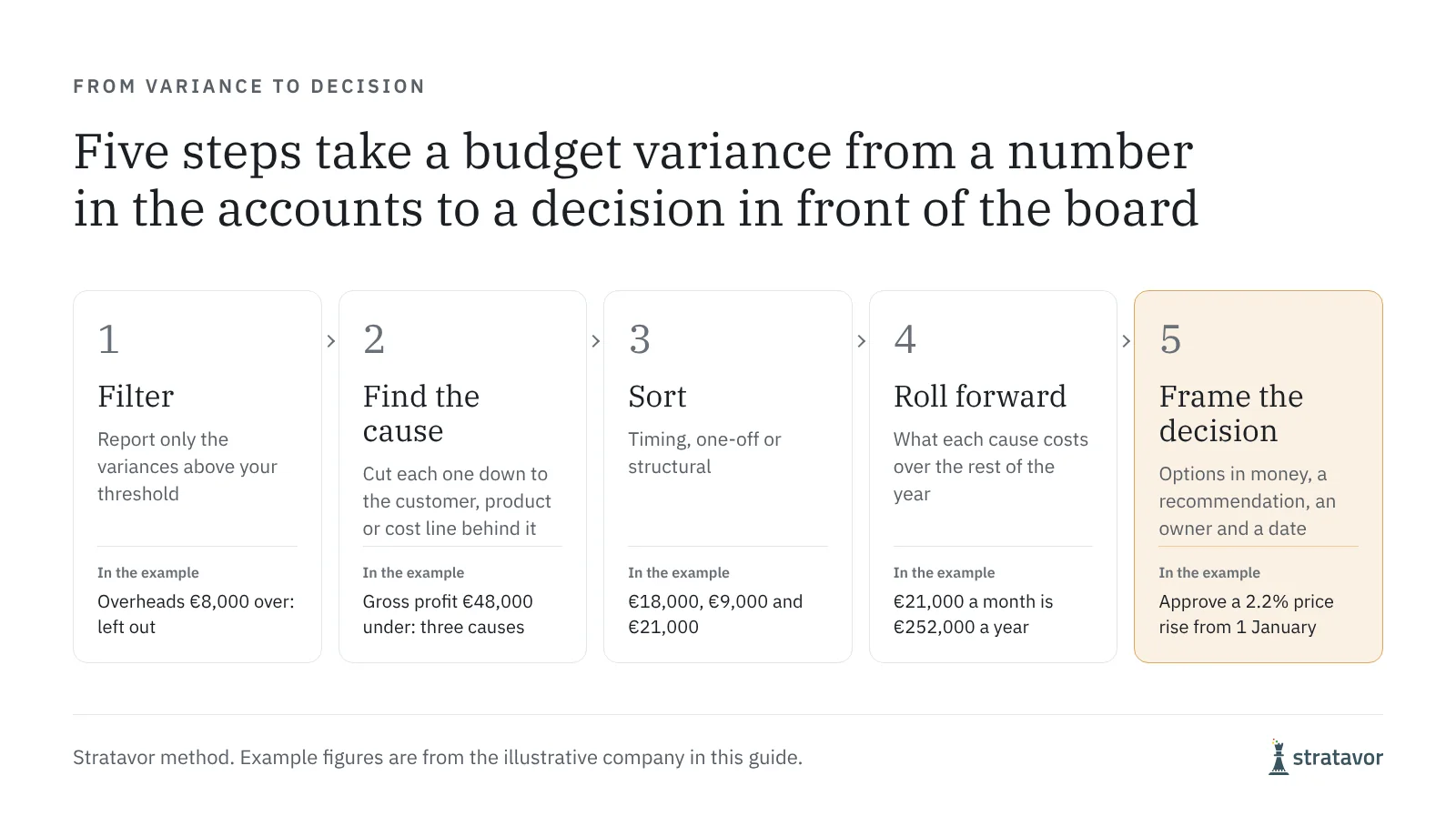
From variance to decision in five steps
- Filter. Report only the variances above your materiality threshold, largest first.
- Find the cause. Cut each one down until one or two customers, products or cost lines explain most of it.
- Sort. Mark each cause as timing, one-off or structural.
- Roll forward. Work out what each cause costs over the rest of the year, and over a full twelve months.
- Frame the decision. For each structural cause, give the board the options in money, a recommendation, an owner and a date.
Step 1: report only what is material
Set the threshold once, in money and as a percentage, and hold to it. For a business with around €10m of revenue, €10,000 or 5% of the line for the month is a common starting point. Everything under it stays out of the commentary, however interesting. A board shown forty variances cannot tell which three matter.
An illustrative company with €12m of annual revenue reports October:
| Line | Actual | Budget | Variance |
|---|---|---|---|
| Revenue | €955,000 | €1,000,000 | €45,000 below |
| Gross profit | €352,000 | €400,000 | €48,000 below |
| Overheads | €318,000 | €310,000 | €8,000 above |
| Operating profit | €34,000 | €90,000 | €56,000 below |
Overheads are €8,000 over, under the threshold in both money and percentage, so they get no commentary. Gross profit is the line to explain.
Step 2: cut the variance down to its cause
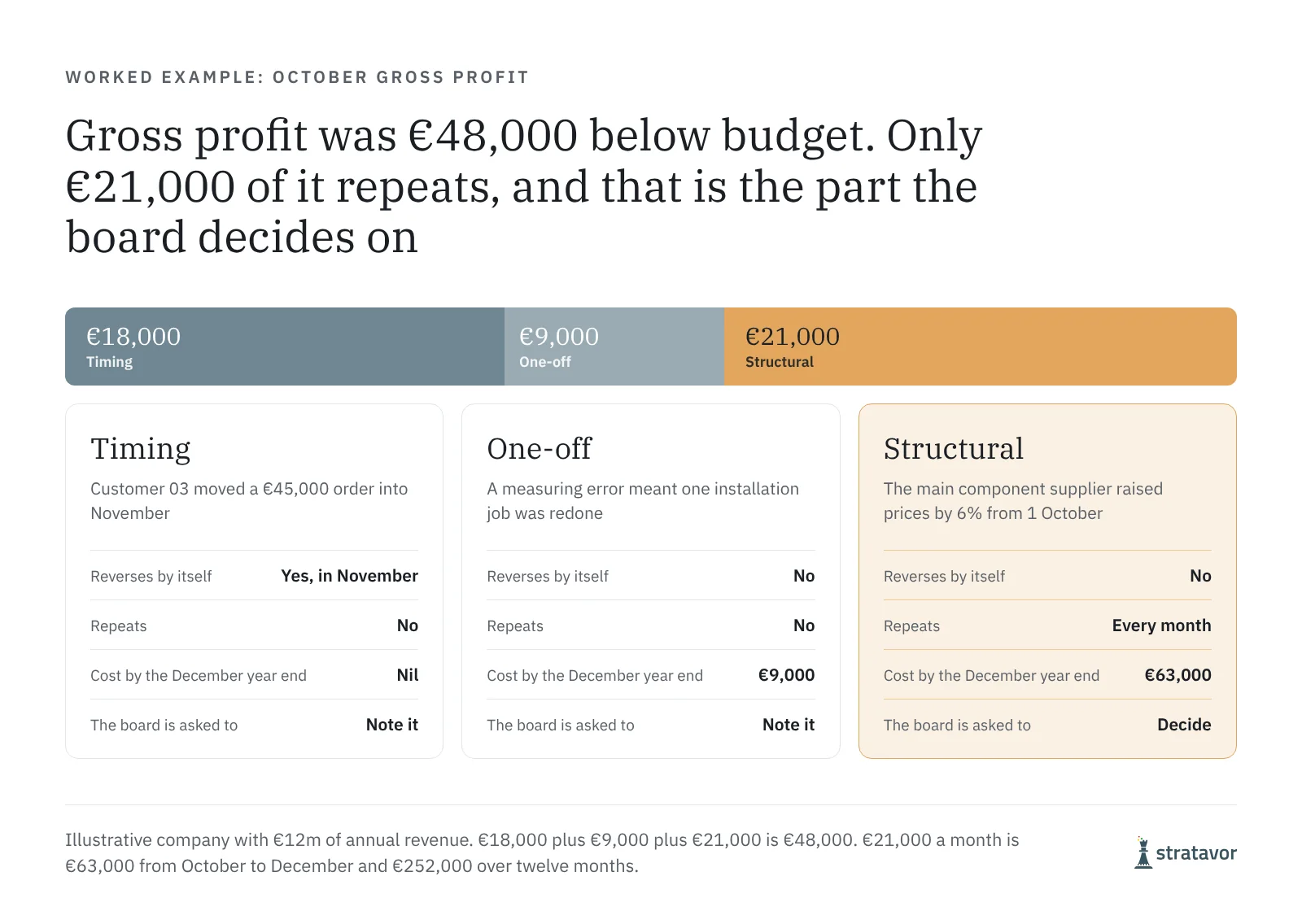
"Gross profit was below budget on lower revenue and higher costs" restates the table. Cut the variance by customer, product line and cost line until each part has one cause. Here the €48,000 has three:
- €18,000 is the margin on a €45,000 order that customer 03 moved from October into November, at the budgeted 40%.
- €9,000 is the cost of redoing one installation job after a measuring error.
- €21,000 is a 6% price rise from the main component supplier, in force from 1 October and not yet passed on to customers.
€18,000 plus €9,000 plus €21,000 is €48,000. If the parts do not add up to the variance, the analysis is not finished.
Step 3: sort each cause
Ask two questions of every cause. Will it reverse by itself? Will it repeat?
| Type | Reverses by itself | Repeats | In the example |
|---|---|---|---|
| Timing | Yes | No | The €45,000 order, invoiced in November |
| One-off | No | No | The €9,000 of rework on a closed job |
| Structural | No | Yes, every month | The supplier's 6% price rise |
Be strict with the word timing. It applies only when you can name the month the amount lands in and the evidence for it, such as a confirmed order or an invoice already raised. A variance that has been called timing for two months running is structural until shown otherwise.
Step 4: roll it forward
A single month understates a structural variance and overstates the other two. Set each cause against the rest of the year:
| Cause | October | By the December year end | Over twelve months |
|---|---|---|---|
| Order moved to November | €18,000 | Nil | Nil |
| Rework on one job | €9,000 | €9,000 | €9,000 |
| Supplier price rise | €21,000 | €63,000 | €252,000 |
The price rise is less than half of October's shortfall. Over twelve months it is €252,000, close to a quarter of the €1,080,000 of operating profit in the plan. That figure, not October's, is what the board needs in front of it.
Step 5: frame the decision
A decision request has five parts: what the board is asked to approve, the options with their effect in money, the recommendation, the owner and the date, and what happens if nothing is decided. In the example:
| Option | Recovers each month | Takes effect | The catch |
|---|---|---|---|
| Pass it on: raise prices by 2.2% | €22,000 | 1 January, with notices to customers by 1 December | Some customers will push back |
| Re-source: move half the volume to a second supplier at the old price | €10,500 | After a 12-week qualification | Covers half the gap, and not before February |
| Absorb it | Nothing | Now | Operating profit runs €252,000 a year below plan |
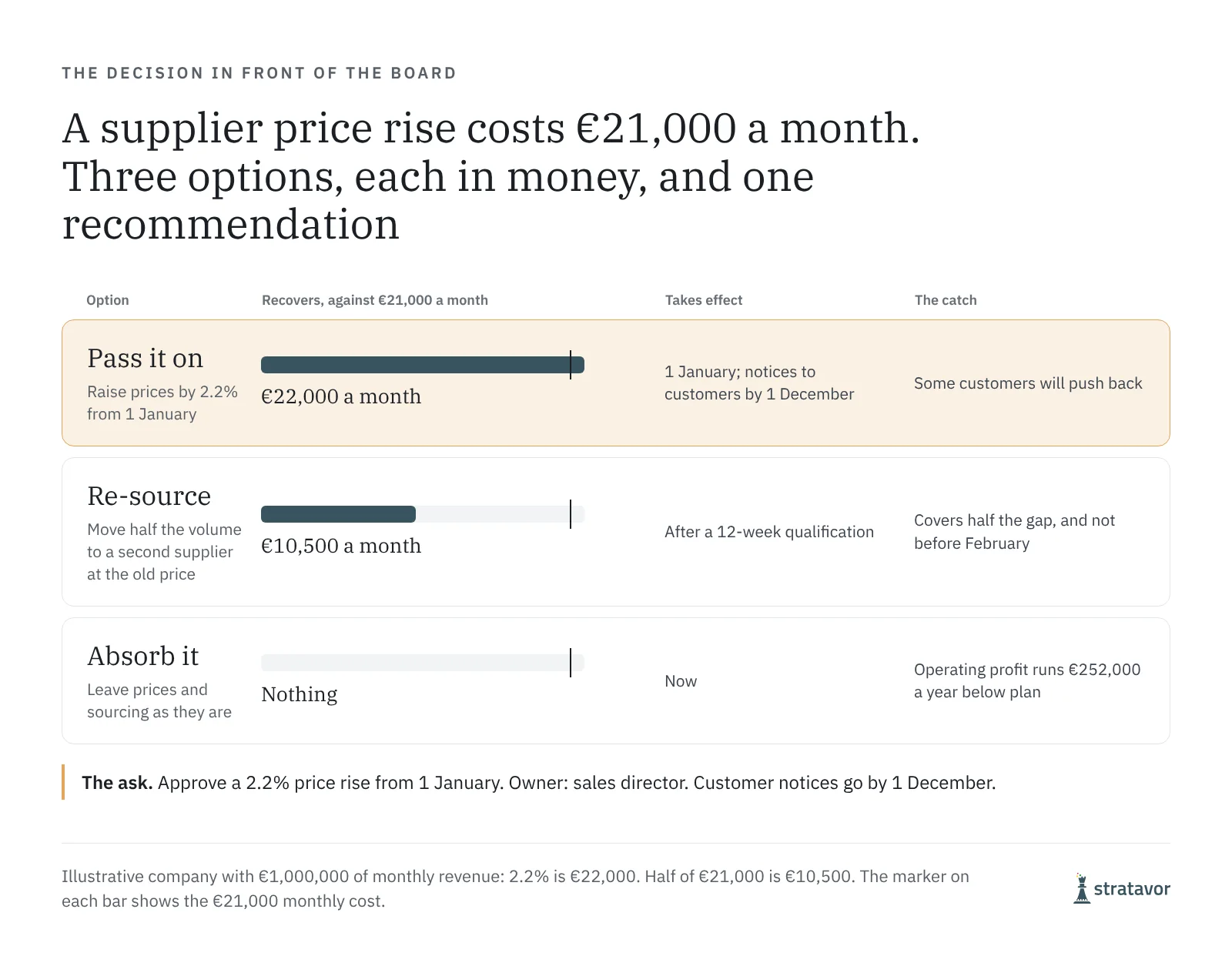
Written for the pack, the request reads: "A 6% supplier price rise is costing €21,000 a month, €252,000 over a year. The board is asked to approve a 2.2% price rise from 1 January, which recovers €22,000 a month. Owner: the sales director. Customer notices must go by 1 December. Management will also qualify a second supplier for half the volume. If neither is approved, operating profit runs €21,000 a month below plan."
That paragraph can be approved, amended or refused in five minutes. "Margins were affected by supplier pricing" cannot.
Where each type goes in the pack
- Timing: for noting. One line, with the month it lands in and the evidence.
- One-off: for noting. One line, with what has been done to stop a repeat.
- Structural: for decision. On the summary page, with the request written out in full. Do not leave it in the middle of the commentary.
Label every item for noting, for discussion or for decision, so directors know what is being asked of them before they read it. Our 12-paragraph board commentary framework shows where the decisions sit in the full commentary.
Keep a decision log, and report back
A decision that is not followed up is another variance next quarter. Keep one table at the back of the pack:
| Decision | Approved | Owner | Expected effect | Review |
|---|---|---|---|---|
| 2.2% price rise from 1 January | November board | Sales director | €22,000 a month | February pack |
| Qualify a second component supplier | November board | Operations director | €10,500 a month once qualified | March pack |
In the review month, report the actual effect against the expected one, in the same form as any other variance. Check the timing items too: if the November order did not arrive, it moves from timing to structural, and the board should hear that before it asks.
Four mistakes that stop a variance becoming a decision
- Calling it timing without a date. Name the month and the evidence, or do not use the word.
- Reporting the month, not the run rate. A €21,000 variance is a €252,000 question.
- Netting good against bad. A favourable variance that hides an adverse one removes the decision from view. Show both.
- Asking without options. "The board is asked to consider margins" is not a request. Give the choices and what each is worth.
Where Stratavor fits
Stratavor connects read-only to Xero, QuickBooks Online, Sage, NetSuite and Deltek Vantagepoint, with HubSpot for customer and pipeline context. It computes every variance from the ledger in code, cuts each material one down to the customers, products or cost lines behind it, and drafts the commentary with the question for the board. The finance lead reviews the draft, sorts what is timing from what is structural and adds the recommendation. Our variance analysis framework and board commentary template are free to use. See how it works or book a demo.
Sources
Frequently asked questions
How do you turn budget variance into board decisions?
In five steps: report only the variances above your threshold; cut each one down to its cause; sort each cause into timing, one-off or structural; roll the structural ones forward over the year; and give the board the options in money, a recommendation, an owner and a date. Timing and one-off variances are for noting; structural ones need a decision.
What is the difference between a timing variance and a structural variance?
A timing variance reverses by itself in a later month, such as an order invoiced in November instead of October. A structural variance repeats every month until something changes, such as a supplier price rise or a discount that has become standard. A one-off does neither: it happened once and will not come back.
Which budget variances should go to the board?
Those above your materiality threshold, and in full only the structural ones. For a business with around €10m of revenue, €10,000 or 5% of the line for the month is a common threshold. Timing and one-off variances get one line each, for noting.
What should a board decision request include?
Five things: what the board is asked to approve, the options with their effect in money, the recommendation, the owner and the date, and what happens if nothing is decided.
How do you explain a budget variance to the board?
Lead with the figure and its cause, say whether it will reverse or repeat, show what it costs over the year, and end with what you need from the board. Keep the detailed cut in an appendix.
How do you follow up a board decision on a variance?
Record it in a decision log with the owner, the expected effect and a review month. In that month, report the actual effect against the expected one, like any other variance.
Can software turn budget variances into board decisions?
It can do the first steps. Stratavor computes each variance in code, names the cause and drafts the question for the board. Sorting timing from structural, choosing between the options and making the recommendation remain the finance lead's judgement.
The Stratavor digest
One email a month. Worth opening.
Decoded films on real companies' results, short films on how businesses make and lose money, and guides on customers, competitors, risk, cash and the board pack. No sales emails.
By subscribing you agree to receive the monthly Stratavor digest. Unsubscribe at any time from any email. Privacy policy.