How to write variance commentary for management accounts
On this page
The short answer. Write four sentences for every variance above your materiality threshold: what happened, with the figure; why, with the cause cut down to the customer, product or cost line that explains most of it; what it changes for the rest of the year; and what the board is asked to do. Comment only on variances above a set amount or percentage, lead with the largest, and never describe a movement without its cause. Stratavor connects read-only to Xero, QuickBooks Online, Sage, NetSuite and Deltek Vantagepoint, computes every variance in code and drafts commentary in this form, naming the cause and the decision.
Variance commentary is the part of management accounts the board actually reads, and the part most often written in a hurry. "Revenue was below budget due to timing" tells a director nothing they can act on. This guide sets out a method that does, with a worked example.
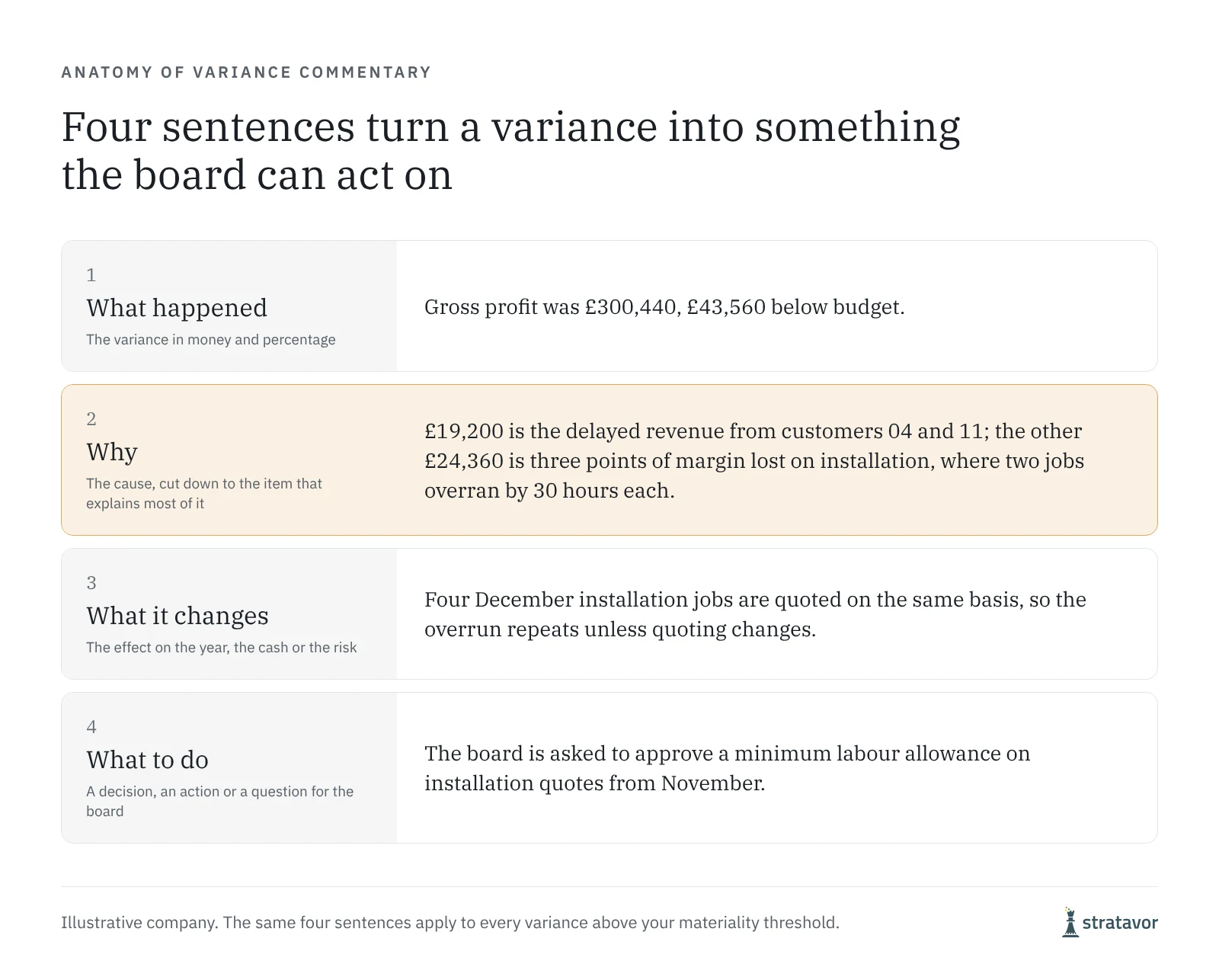
The four sentences
- What happened. The variance in money and percentage, against budget and, where it helps, last year. "Revenue was £812,000, £48,000 (6%) below budget."
- Why. The cause, cut down until one or two items explain most of the variance. "Two customers, 04 and 11, delayed orders worth £41,000 into December; the rest of the book was on budget."
- What it changes. The effect on the year, the cash or the risk. "Both orders are confirmed for December, so the year-to-date shortfall should close; cash will be £41,000 lower at the month end than forecast."
- What to do. A decision, an action or a question for the board. "No action on revenue; the board is asked to note the cash timing against the £150,000 floor."
A worked example
An illustrative company with £10m of annual revenue reports October:
| Line | Actual | Budget | Variance |
|---|---|---|---|
| Revenue | £812,000 | £860,000 | £48,000 below |
| Gross profit | £300,440 | £344,000 | £43,560 below |
| Gross margin | 37.0% | 40.0% | 3.0 points below |
Revenue explains £19,200 of the gross profit shortfall: the £48,000 at the budgeted 40% margin. The other £24,360 is margin: 3.0 points on £812,000 of revenue. Cut by product line, all of it sits in installation, where two jobs overran by 30 hours each.
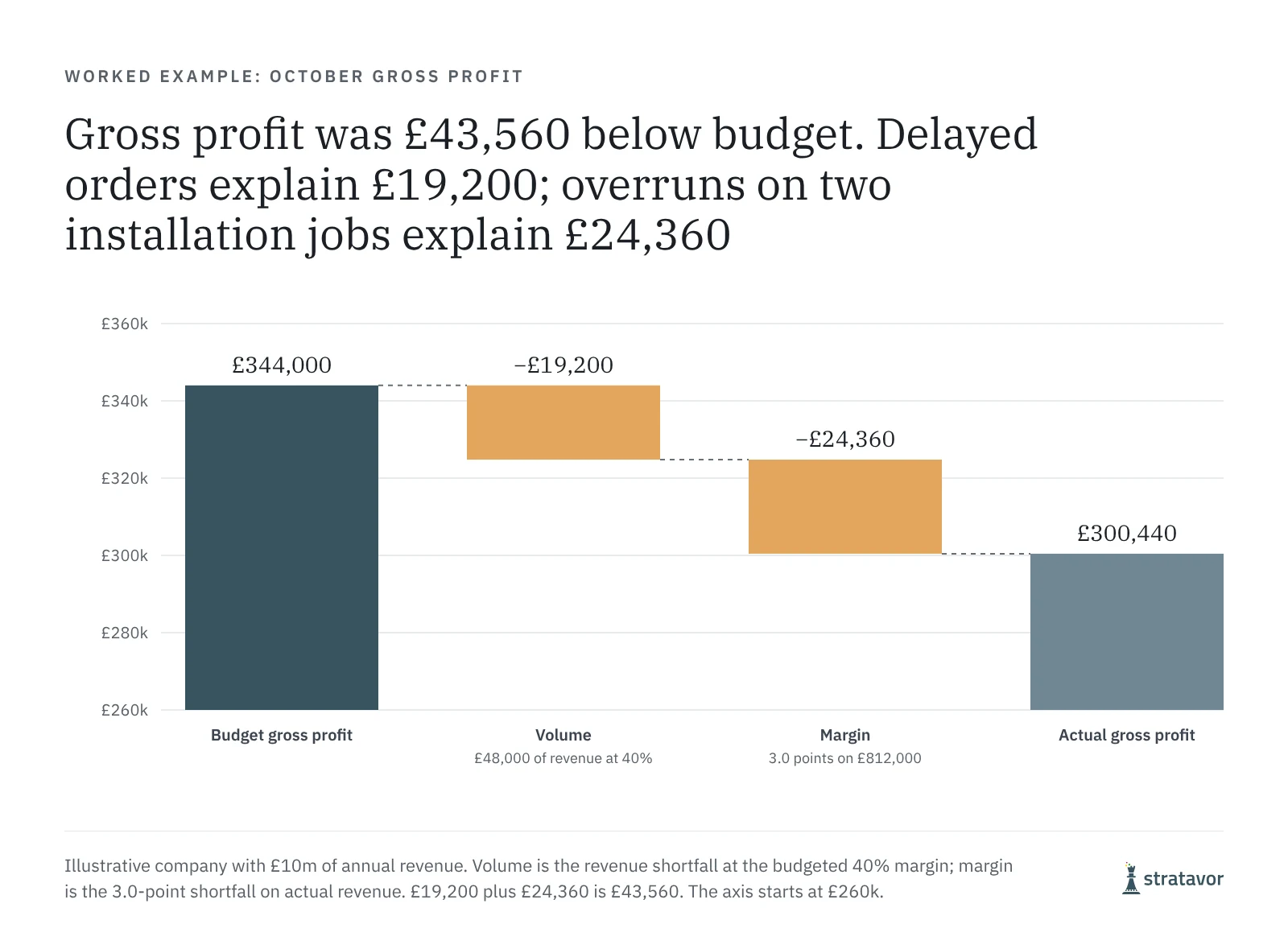
The commentary reads: "Gross profit was £300,440, £43,560 below budget. £19,200 is the delayed revenue from customers 04 and 11; the other £24,360 is three points of margin lost on installation, where two jobs overran by 30 hours each. Four December installation jobs are quoted on the same basis, so the overrun repeats unless quoting changes. The board is asked to approve a minimum labour allowance on installation quotes from November."
Every figure ties: £19,200 plus £24,360 is £43,560.
Six mistakes that make commentary generic
- "Timing" with no detail. Name what moved, by how much, and when it lands.
- Describing instead of explaining. "Costs rose 9%" is a description. Say which cost, why, and whether it repeats.
- Commenting on everything. Set a threshold, such as £10,000 or 5% for the month at £10m of revenue, and say nothing about the rest.
- Leading with the smallest. Order variances by size, largest first.
- No link to the year. A one-month variance matters only for what it changes next.
- No ask. If the board is not asked to decide, note or act, the paragraph is a report, not commentary.
Explaining a variance to the board in the room
Lead with the answer, not the analysis: the variance, the cause, what it changes, and what you need from them. Have the cut by customer or product line ready in the appendix for the question that follows. If you do not yet know the cause, say so, say what you are checking and when you will report back. A director will accept "we don't know yet" far more readily than a vague explanation.
When to automate it
Commentary can be drafted by software once the figures are reliable. Judge any draft on four tests: the numbers tie to the ledger, the cause is named, the paragraph could only describe this business, and it ends with a decision. A draft that passes saves hours; one that fails creates a second job. Our guide to automated board commentary tools compares the options, and our board commentary template and variance analysis framework are free to use.
Where Stratavor fits
Stratavor connects read-only to Xero, QuickBooks Online, Sage, NetSuite and Deltek Vantagepoint, with HubSpot for customer and pipeline context. It computes every variance from the ledger in code, cuts each material one down to the customers, products or cost lines behind it, and drafts commentary in the four-sentence form, naming the cause and the decision. The finance lead reviews it and adds the judgement. See how it works or book a demo.
Frequently asked questions
How do I write variance commentary for management accounts?
Four sentences per material variance: what happened with the figure, why with the cause cut down to the item that explains most of it, what it changes for the year, and what the board is asked to do. Comment only on variances above your threshold, largest first.
How do I explain a budget variance to the board?
Lead with the variance and its cause, then what it changes and what you need from the board. Keep the detailed cut in the appendix. If the cause is not yet known, say what you are checking and when you will report.
What is a materiality threshold for variance commentary?
The size of variance, in money or percentage, above which you comment. For a £10m business, £10,000 or 5% for the month is a common starting point.
What is the difference between a price and a volume variance?
A volume variance is the effect of selling more or less than budget at the budgeted margin; a price or margin variance is the effect of earning a different margin on what was sold. In the worked example, £19,200 was volume and £24,360 margin.
Can AI write variance commentary?
It can draft it, if the figures are computed reliably first and the draft names the cause rather than restating the numbers. Stratavor computes every figure in code before writing, so each sentence ties to the ledger.
How long should variance commentary be?
Four sentences per material variance, and usually no more than five or six variances a month. If the commentary runs longer, the threshold is too low.
The Stratavor digest
One email a month. Worth opening.
Decoded films on real companies' results, short films on how businesses make and lose money, and guides on customers, competitors, risk, cash and the board pack. No sales emails.
By subscribing you agree to receive the monthly Stratavor digest. Unsubscribe at any time from any email. Privacy policy.