Automated board commentary tools compared: Fathom, Spotlight, QuickBooks, NetSuite and Stratavor
On this page
The short answer. Fathom's Commentary Writer drafts commentary section by section inside its reports and shows the breakdown of every figure it writes. Spotlight Reporting's AI executive summary calculates the figures first and lets you accept, edit or reject each suggestion. QuickBooks Online Advanced adds an AI-generated executive summary to management reports. NetSuite's Narrative Insights summarises a limited set of standard reports. Planning platforms such as Datarails, Cube, Vena and Planful draft commentary inside their own models. Stratavor computes every figure from the ledger in code, then writes commentary on each material movement with the question for the board. Whichever you use, test the draft: the numbers tie, the cause is named, it is about this business, and it ends with a decision.
Most of the main reporting tools now write financial commentary of some kind. That is useful, and it raises a new question for finance teams: which drafts can go to a board after a light edit, and which have to be rewritten. This guide sets out where each tool writes, what each vendor says about how the figures are handled, and four tests that apply to any of them.
Where each tool writes, and how it handles the figures
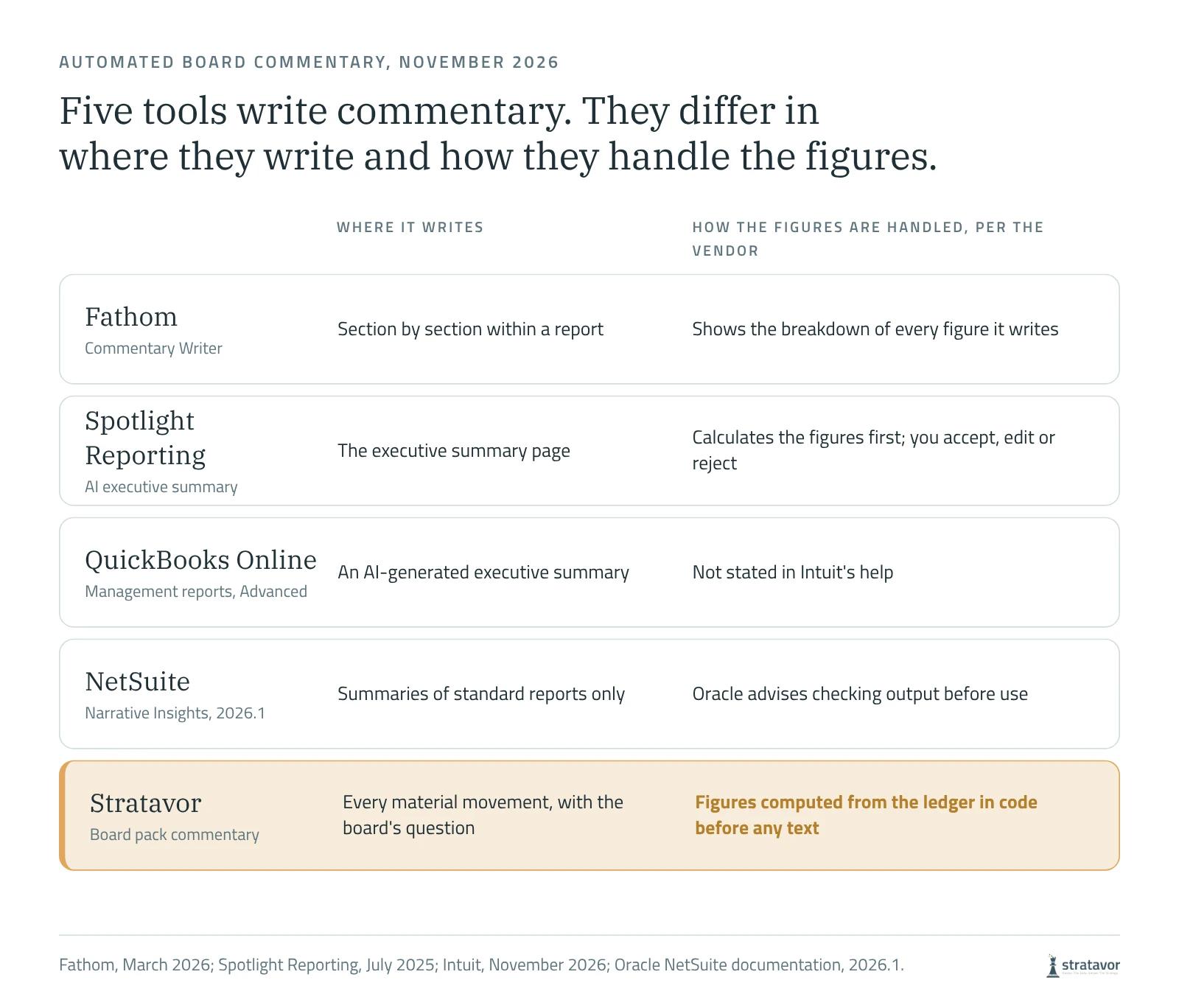
Fathom. Commentary Writer generates commentary for individual report sections rather than whole reports; Fathom moved to that approach after finding that whole-report input reduced quality. Users can add context about their business, and what Fathom calls symbolic attribution cross-references every figure the AI writes and shows the breakdown of each calculation.
Spotlight Reporting. The AI executive summary can enhance commentary you have started or write a summary from scratch. Spotlight says it calculates the figures first and layers AI insights on top, and you can accept, edit or reject each suggestion.
QuickBooks Online. On the Advanced plan, management reports include AI-generated executive summaries alongside chart widgets and KPI scorecards. Intuit's help does not describe how the figures are handled. Our guide to board packs from QuickBooks Online covers what each plan includes.
NetSuite. Narrative Insights, in the 2026.1 release, writes one-click summaries of a limited set of standard reports, not customised ones. Oracle notes the content can differ each time and advises checking it before use. Our NetSuite board pack guide covers the detail.
Stratavor. Every figure is computed from the ledger in code before any text is written. The language model writes the explanation around figures that have already been checked, on each material movement, naming its cause and the question for the board.
The planning platforms draft commentary too, on the same model as the budget:
| Suite | What its AI writes | What the vendor says about the figures |
|---|---|---|
| Datarails | AI chat, agents for recurring analyses, and AI Storyboards that build presentations from dashboards | Its agents work on Datarails' governed data |
| Cube | A Business Partner agent drafts commentary from the drivers for finance to edit | Every figure traces to the transaction |
| Vena | Vena AI surfaces variances and explains changes, and an Analytics Agent answers questions about them | The Analytics Agent shows how it reached each answer |
| Planful | Analyst Assistant summarises key variances and explains anomalies | The final judgement stays with the user |
They suit a team that already plans in the suite; our Datarails alternatives guide compares the platforms themselves. Xero's JAX announcements at Xerocon in August 2026 focused on admin work and cash flow actions rather than written commentary.
Four tests for any draft
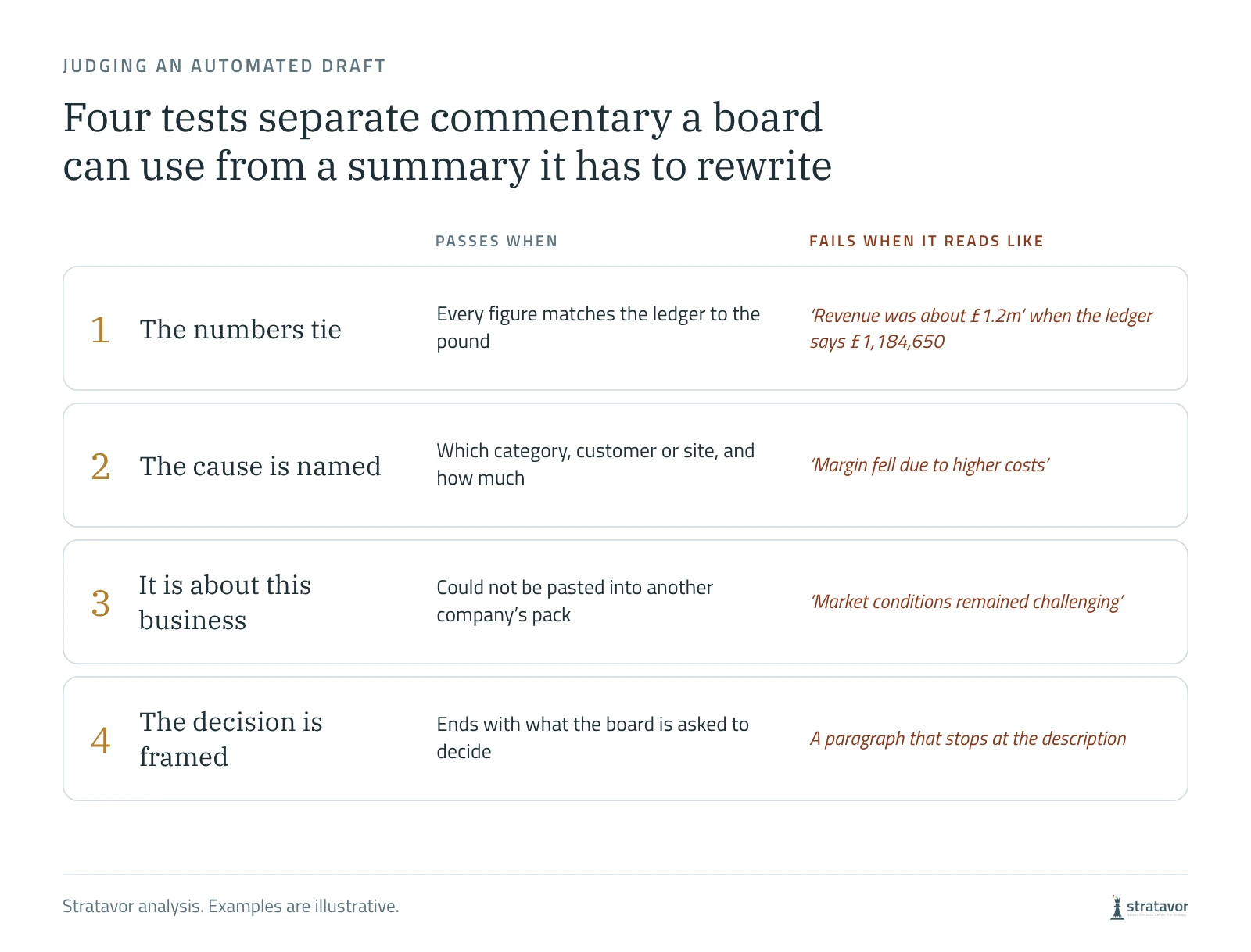
- The numbers tie. Every figure in the draft matches the ledger to the pound. A rounded or approximate number in board commentary invites the question of what else is approximate.
- The cause is named. The draft says which category, customer or site drove the movement, and how much of it. That depends on the ledger carrying the tags, so the test is partly about your books, not the tool.
- It is about this business. If the paragraph could be pasted into another company's pack, it is padding.
- The decision is framed. The draft ends with what the board needs to decide.
Most tools pass the first test by design or let you check it. The second and fourth are where drafts differ most, because naming a cause needs the data cut down to the driver, and framing a decision needs the draft to say what the movement changes.
Is AI accurate enough for board commentary?
It is accurate enough when the figures come from the ledger and the language model only writes the words around them. The risk is a model that calculates or rounds a figure itself, or summarises a movement without the data to explain it. Ask any vendor two questions: where do the numbers in the text come from, and can I trace each one back to the ledger? Then review every draft before it reaches the board. The tools save the writing time; the judgement on what the board should hear stays with the finance team.
Choosing between them
| If you need | Look at |
|---|---|
| Commentary inside a reporting app you already use for Xero or QuickBooks | Fathom or Spotlight Reporting |
| A quick summary page inside QuickBooks itself | QuickBooks Online Advanced |
| A summary of NetSuite's standard reports | NetSuite Narrative Insights |
| Commentary on the same model as the budget, inside a planning platform | Datarails, Cube, Vena or Planful |
| Commentary on every material movement, with the cause and the board's question, across Xero, QuickBooks, Sage, NetSuite or Deltek | Stratavor |
Stratavor is not a forecasting tool and pairs well with Fathom, Spotlight Reporting or Syft for the outlook. For a working method that applies whichever tool you choose, see our guide to board packs for many clients or talk to us.
Sources
Checked on 10 November 2026; the planning platforms on 14 November 2026.
- Fathom: behind the build, Commentary Writer, 19 March 2026
- Spotlight Reporting: AI for the executive summary, 15 July 2025
- Intuit QuickBooks UK: view and edit management reports
- Oracle NetSuite: Narrative Insights overview
- Datarails: cost and features
- Cube: executive reporting
- Vena: consolidation and AI announcement at Excelerate 2026
- Planful: Analyst Assistant, 8 October 2025
- Accounting Today: Xerocon 2026 and JAX, 24 August 2026
Frequently asked questions
What are the alternatives to Fathom and Spotlight for automated board commentary?
QuickBooks Online Advanced adds an AI executive summary to management reports, NetSuite's Narrative Insights summarises standard reports, and Stratavor writes commentary on every material movement from figures computed in code, across Xero, QuickBooks, Sage, NetSuite and Deltek.
Do FP&A suites such as Datarails, Cube, Vena or Planful write board commentary?
Yes, in different ways. Datarails offers AI chat, agents and AI Storyboards; Cube's Business Partner agent drafts commentary from the drivers for finance to edit; Vena AI explains changes in variances; Planful's Analyst Assistant summarises key variances. Each works inside its own planning model, so it suits a team that already plans there. Judge any draft on the four tests above.
Is AI accurate enough to write financial commentary for a board?
Yes, when the figures come from the ledger and the model only writes the words around them. Ask where each number comes from and whether you can trace it, and review every draft before it reaches the board.
Why is my board commentary always generic?
Usually because the ledger does not carry the tags that would let anyone name a cause, or because there is no time to cut each variance down to it. Tag income and costs, budget by the same tags, and write four sentences per variance: what happened, why, what it changes and what to do.
Does Fathom's Commentary Writer calculate the numbers?
Fathom describes Commentary Writer as deeply integrated with structured financial data, with symbolic attribution showing the breakdown of every figure the AI writes. Check each figure against the report before it goes to the board.
Which tool writes the best board commentary?
Judge each on the four tests: the numbers tie, the cause is named, it is about this business, and it ends with a decision. The best tool for you is the one whose drafts pass all four with the least editing.
How is Stratavor different?
Stratavor computes every figure from the ledger in code first, then writes commentary on each material movement that names its cause and frames the question for the board, for single companies and across groups.
The Stratavor digest
One email a month. Worth opening.
Decoded films on real companies' results, short films on how businesses make and lose money, and guides on customers, competitors, risk, cash and the board pack. No sales emails.
By subscribing you agree to receive the monthly Stratavor digest. Unsubscribe at any time from any email. Privacy policy.