How to build a risk register without a risk manager
On this page
The short answer. A risk register for a business without a risk manager fits on one page. It lists the 10 to 15 risks that could knock the plan off course, each with one owner, a score for likelihood and impact, the controls already in place, a measure with a threshold that triggers action, and the next step with a date. Tie as many measures as you can to numbers you already report, such as customer concentration, debtor days, cash headroom and margin by line, so the register moves with the monthly accounts. Review it for 30 minutes each month and take the highest-scoring risks to the board each quarter. Stratavor's free Risk Register Template sets this out on one page in Excel, with twelve example risks and a heat map.
Most small businesses that have a risk register wrote it once, for a lender or an investor, and have not opened it since. It runs to 60 rows, every risk is amber, and nobody can say which three matter this month. A register like that is worse than none, because it suggests the risks are managed when nobody is watching them.
A useful register is short, owned and tied to numbers. ISO 31000, the international standard for risk management, defines risk as the effect of uncertainty on objectives. For a growing business, the objectives are the plan: the revenue, margin and cash it expects this year. The register's job is to show the leadership team what could knock that plan off course, and what is being done about it. This guide sets out the columns, the risks most SMEs carry, how to measure each one, and a monthly routine that keeps the register alive. A risk register template with all of it is free to download.
Who expects a risk register
Listed companies now face firmer rules. Under the UK Corporate Governance Code 2024, boards of companies listed in the commercial companies category are asked to declare, on a comply or explain basis, whether their material internal controls were effective, for financial years beginning on or after 1 January 2026. The Code does not apply to private companies, as the Financial Reporting Council states. But the questions behind it travel: lenders ask about them at renewal, investors in due diligence, and buyers before a sale. A business that can show a live register answers them in minutes.
The columns
Nine columns are enough. Each risk is written in one sentence that names the cause, the event and the effect in money, so that anyone reading it can see why it matters.
| Column | What goes in it | Example |
|---|---|---|
| Risk | Cause, event and effect, in one sentence | Our largest customer moves most of its range to a competitor, cutting gross profit by €600,000 a year |
| Owner | One named person, never a team | Sales director |
| Likelihood | 1 to 5 over the next 12 months | 3, possible |
| Impact | 1 to 5, using money bands set for your size | 5, more than €500,000 of profit |
| Score | Likelihood times impact | 15 |
| Measure and threshold | A number that moves before the risk lands, and the level that triggers action | Largest customer above 20% of revenue, or its orders down a third |
| Controls | What is already in place | Quarterly account review; supply agreement to March 2028 |
| Next action and date | The one thing being done next, and by when | Open renewal talks by 31 January |
| Trend | Up, down or steady since last month | Up |
Set the impact bands once, in money, so a 4 means the same thing to everyone. For a business with revenue of around €10m, a reasonable starting point is: 1 under €25,000 of profit, 2 up to €100,000, 3 up to €250,000, 4 up to €500,000 and 5 above that or a threat to the business. Likelihood works the same way: 1 below 5% over the next year, 2 up to 20%, 3 up to 50%, 4 up to 80% and 5 above that.
Twelve risks most SMEs carry
Start from the plan, not from a generic list. Ask what would most damage this year's revenue, margin or cash, and work back to the causes. For most businesses with revenue between €1m and €50m, the answers fall into the same groups: customers, competitors, cash, people, suppliers, systems and rules.
- Customers: the largest customer cuts its orders; customer losses lower retention.
- Competitors and markets: price pressure on the main line; a fall in demand in a key sector.
- Cash and funding: cash headroom runs short; debtors pay later; a bank covenant is breached.
- People: a key person leaves without a handover.
- Suppliers: the largest supplier fails or raises its prices.
- Systems: a cyber incident stops invoicing; staff put customer data into unapproved AI tools.
- Rules: a change in tax or reporting rules adds cost or work.
Cyber risk belongs on almost every list. In the Allianz Risk Barometer 2026, published in January 2026, cyber incidents ranked first among business risks for companies of every size. For companies with revenue under US$100m, artificial intelligence was in the top three, changes in legislation and regulation ranked third and business interruption fourth.
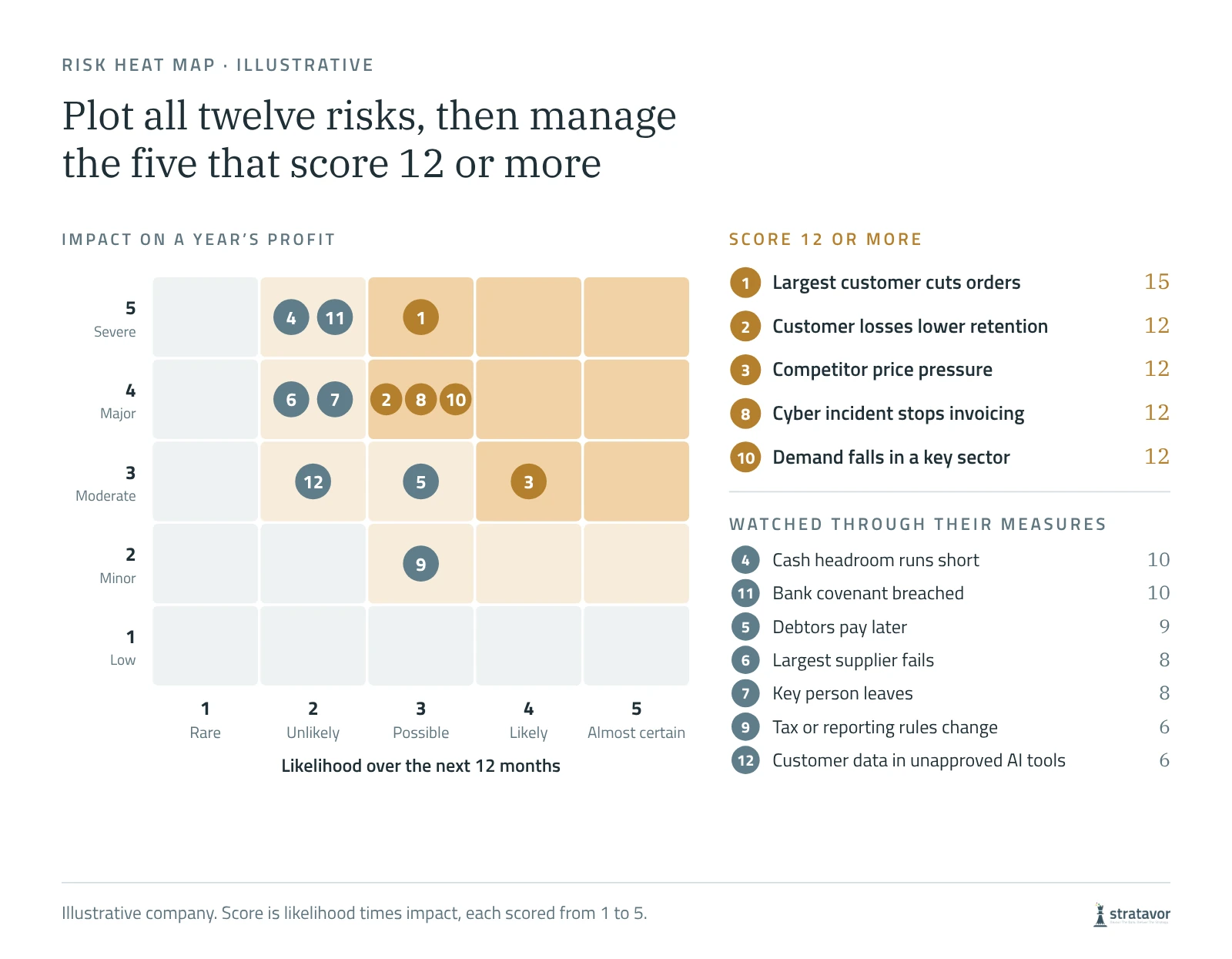
Plot all twelve, then manage the few in the top corner. In the example, five risks score 12 or more. Those five get a named action and a date every month. The rest are watched through their measures and reviewed when a threshold is crossed.
Tie each risk to a measure
A risk without a measure is an opinion. A measure with a threshold tells you when to act, and many of the best measures are already in the monthly accounts.
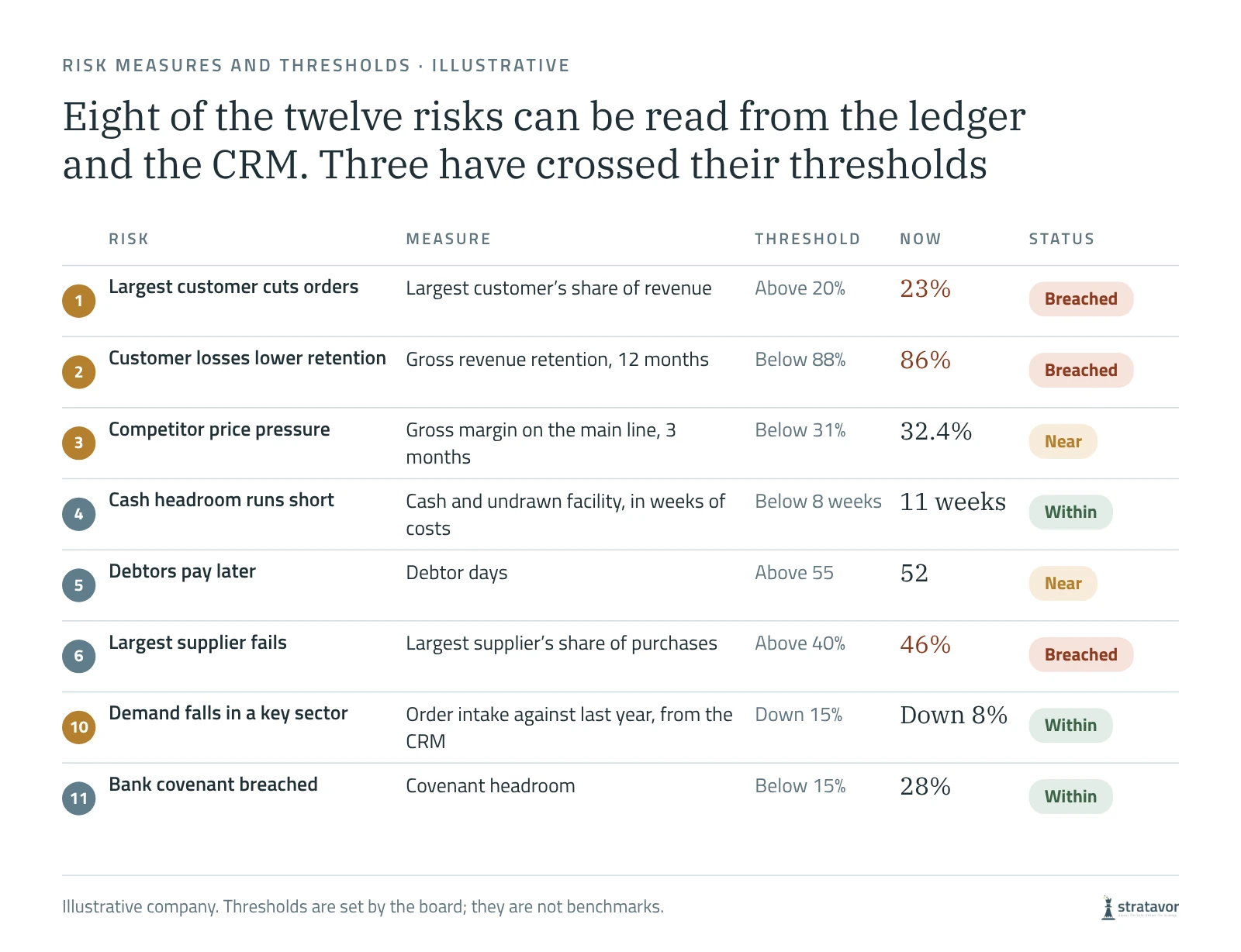
In the example, eight of the twelve risks can be read straight from the ledger and the CRM. Three have crossed their thresholds: the largest customer has grown to 23% of revenue, gross revenue retention has fallen to 86%, and the largest supplier now takes 46% of purchases. Those three need a named action this month, whatever their scores said a quarter ago.
The other four risks need simple operational measures: for a key person leaving, whether month-end and banking procedures are written down; for a cyber incident, the days since backups were last restored in a test; for a change in rules, the date of the next known change; and for AI tools, whether a policy is in place and followed.
The 30-minute monthly review
- Update the measures with the month's management accounts, before the meeting. This takes ten minutes when the measures come from the ledger.
- Look only at what moved. Discuss the risks that crossed a threshold or changed trend; leave the rest.
- Ask each owner for the next action and date. If the last action was missed, say so.
- Add or retire risks. When a new risk comes in, check whether an old one can go, so the register stays at one page.
- Take the top risks to the board each quarter, with what changed, what the measures show and what is being done.
Showing the register to a board, lender or investor
Lead with the five risks that score highest and the three measures that crossed a threshold. Show the trend, not just the score. A register that changes from month to month, with actions closed and new risks added, is more convincing than a perfect one that never moves.
Where software helps
The work in a register is judgement: which risks matter and what to do about them. The measures should not take judgement or time. Stratavor connects read-only to Xero, QuickBooks Online, Sage, NetSuite, Deltek Vantagepoint and HubSpot, computes every figure in code from the ledger and the CRM, and flags concentrations, threshold breaches and early warning signs in the monthly commentary, so the measures in the register come from the same numbers as the management accounts. The Power BI add-on carries the same figures and commentary into Power BI. For the customer measures, see which customers are about to leave, and for cash, runway maths that survives a board meeting.
Download the risk register template (Excel).
Sources
Checked on 11 November 2026.
- ISO: The new ISO 31000 keeps risk management simple, February 2018
- Financial Reporting Council: UK Corporate Governance Code 2024
- Allianz Commercial: Allianz Risk Barometer 2026, top risks by company size, January 2026
Microsoft and Power BI are trademarks of the Microsoft group of companies.
Frequently asked questions
What should a risk register include?
For each risk: a one-sentence description of the cause, event and effect, one owner, a likelihood and impact score from 1 to 5, the combined score, a measure with a threshold that triggers action, the controls already in place, the next action with a date, and the trend since last month.
Which risks should an SME board review every quarter?
The four or five that score highest on the register, plus any whose measure has crossed its threshold since the last meeting. For most businesses with revenue between €1m and €50m they come from the same groups: the largest customer, competitor price pressure, cash headroom and bank covenants, key people, the largest supplier, cyber incidents and changes in tax or reporting rules. Show each with its score, its measure against the threshold, the trend and the next action with a date.
Where can I find a risk register template for a small business?
Stratavor's free Risk Register Template sets out the nine columns on one page in Excel, with twelve example risks and a heat map. Any spreadsheet will do if it keeps one named owner per risk and a measure with a threshold for each.
How many risks should a small business risk register have?
Between 10 and 15. Fewer usually means something important is missing; more means nobody will read it. Plot them on a heat map and manage the four or five that score highest most closely.
Who should own the risk register in a small company?
The managing director or chief executive owns the register as a whole, and the finance lead usually keeps it up to date. Each risk has one named owner, the person best placed to act on it, never a team.
How often should a risk register be reviewed?
Monthly by the leadership team, alongside the management accounts, for about 30 minutes, and quarterly by the board. Review a risk at once if its measure crosses a threshold between meetings.
What is the difference between a risk register and a risk assessment?
A risk assessment is the exercise of identifying and scoring risks, often for a specific activity, such as a health and safety assessment. The register is the living record that results: the risks, their owners, measures and actions, updated as things change.
Do private companies need a risk register?
Outside specific duties, such as health and safety risk assessments, most private companies are not required to keep a business risk register. The UK Corporate Governance Code's controls declaration applies to listed companies. Lenders, investors and buyers often ask for one all the same, and a short register is the quickest way to answer their questions.
The Stratavor digest
One email a month. Worth opening.
Decoded films on real companies' results, short films on how businesses make and lose money, and guides on customers, competitors, risk, cash and the board pack. No sales emails.
By subscribing you agree to receive the monthly Stratavor digest. Unsubscribe at any time from any email. Privacy policy.