What is a strategic intelligence platform? A guide for finance leaders
On this page
The short answer. A strategic intelligence platform reads a company's own systems (the accounting ledger, the ERP and the CRM) and tells the people who run the business what changed, why it changed and what to decide. It is easy to confuse with three other kinds of software: market intelligence platforms, which research competitors and markets from the outside; planning and FP&A tools, which build budgets and forecasts; and BI tools, which show figures and leave the reading of them to you. The name is used loosely, so test any product on four points: it connects to your ledger and CRM, it computes every figure from the source and shows where each one came from, it explains each material movement in writing, and it says what to decide. Stratavor is a strategic intelligence platform for businesses of roughly €1m to €50m revenue: it connects read-only to Xero, QuickBooks Online, Sage, NetSuite, Deltek Vantagepoint and HubSpot, computes every figure in code, and writes the commentary on what moved and why.
Search for "strategic intelligence platform" and the results describe two different markets. One is market and competitive intelligence: AlphaSense calls itself an "all-in-one market intelligence platform", and searches company filings, earnings transcripts, analyst research, expert interviews and news. The other is planning software for finance teams: Pigment describes itself as a business planning and performance management platform, and Cube as a financial intelligence platform for FP&A teams.
Neither is what a managing director or a finance director usually means when they ask for intelligence on their own business. They want an account of the month: what moved in revenue, margin, cash and costs, which customers and suppliers are behind it, and what the board should do about it. This guide sets out what a strategic intelligence platform does with a company's own data, how it differs from the tools it is confused with, and how to test one before you buy.
What a strategic intelligence platform does
It does four jobs, in this order, every month.
- It connects to the systems of record. The ledger in the accounting system or ERP holds what happened; the CRM holds who the customers are and what is in the pipeline. The platform reads both directly, with read-only access, so nobody exports spreadsheets and nothing can be posted back.
- It computes the figures from the source. Profit and loss, balance sheet, cash, working capital, customer and product mix and cost structure are calculated from the ledger lines and checked back to the ledger, so every figure in a report traces to the transactions behind it.
- It explains what moved and why. For each material movement it names the cause: the customers, products, suppliers or cost lines that account for it. It also flags what the totals hide, such as a customer whose orders are falling, a supplier taking a growing share of purchases, or debtor days creeping up.
- It says what to decide. The output is written for the people who run the business: a management report or board pack with commentary on every material movement, what it means, and the question it raises for the board. Follow-up questions are answered from the company's own figures, with the source of each figure shown.
How it differs from the tools it is confused with
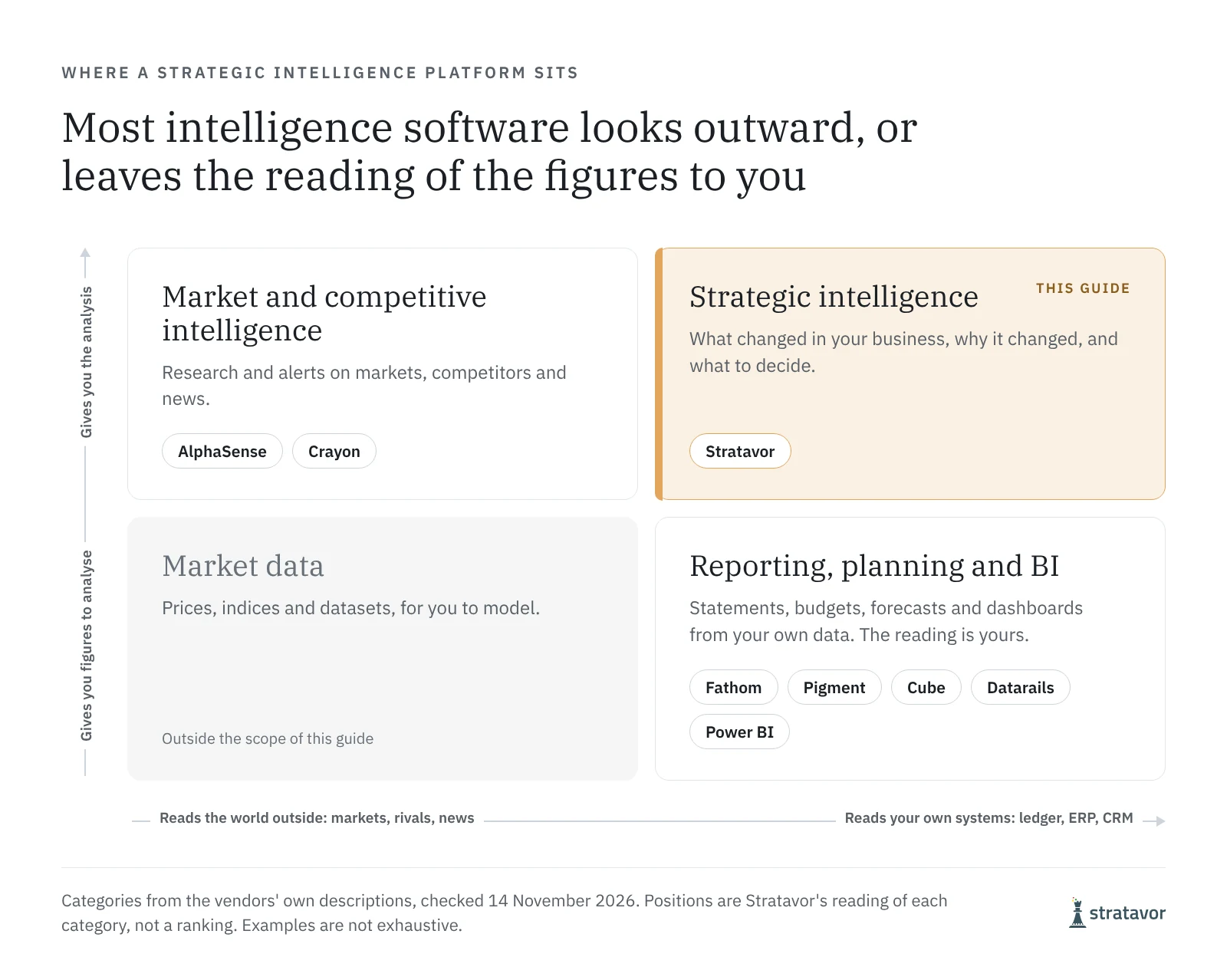
The difference is in what each kind of software reads, and what it hands back to you.
| Kind of software | What it reads | What it gives you | Examples |
|---|---|---|---|
| Market and competitive intelligence | Filings, analyst research, news, competitors' websites and prices | Research and alerts on markets and rivals | AlphaSense, Crayon |
| Planning and FP&A | The ledger, plus budgets, drivers and assumptions | Budgets, forecasts and scenarios | Pigment, Cube, Datarails |
| Reporting apps | The accounting system | Statements, KPIs, management reports and forecasts | Fathom |
| BI and dashboards | Any data you model | Charts and dashboards that you read yourself | Power BI |
| Strategic intelligence | The ledger, the ERP and the CRM | What changed, why, and what to decide, in writing | Stratavor |
Market intelligence looks outward. Crayon, for example, says its software "monitors your competitors and captures intelligence in real-time", tracking their websites, pricing, job postings and press releases. That is useful to a strategy or product team, but it does not read your ledger, so it cannot say why your own margin fell last month.
Planning and FP&A tools look forward. Their strength is the plan: budgets, forecasts and scenarios, such as what happens to cash if a contract slips. Datarails calls itself "the AI operating system for finance teams" and works alongside Excel. A strategic intelligence platform does not replace a planning tool; it sets actuals against the budget you already keep and explains the gap.
Reporting apps sit on the accounting system. Fathom describes itself as "financial analysis, management reporting, multi-entity consolidation, and cash flow forecasting software", and connects to QuickBooks, Xero, MYOB and Sage. Reporting apps are the natural home for statements, KPIs and forecasts.
BI tools are general. Microsoft describes Power BI as its "business analytics platform that helps you turn data into actionable insights". Someone has to model the data and build the reports, and the reading of them is left to whoever opens them.
A strategic intelligence platform looks inward, and its output is the explanation. It works beside the others: a business can keep its planning tool for the budget and its BI tool for operational dashboards, and use a strategic intelligence platform for the monthly account of what happened and what to do about it.
Four tests before you choose one
Because the name is used loosely, judge any product, Stratavor included, on what it does with your data.
- It reads your systems directly. It should list your accounting system or ERP and your CRM among its live connections, connect with read-only access, and run without spreadsheet exports.
- Every figure is computed from the source and can be traced. Open any figure in a report and ask to see the ledger lines behind it. Ask whether a language model ever does the arithmetic. It should not.
- It explains each material movement in writing. Commentary should name causes, such as the customers, products or cost lines behind a movement, rather than restate the table in sentences.
- It says what to decide. A report should end in questions and decisions for the board, not in more charts.
Then the practical questions: where your data is held and which sub-processors handle it, whether the provider can write to your systems (it should not be able to), how long your data is kept after you leave, and what it costs for your number of companies and users.
Who uses one
The people who run the business, and the people who prepare its numbers: owners, managing directors, boards and leadership teams, and the finance directors, fractional CFOs and accountants who work beside them. It matters most where the finance team is small and the monthly pack takes days to write. Groups with their own planning teams can keep their planning suite and use a strategic intelligence platform for the written analysis across their companies.
Where Stratavor fits
Stratavor is a strategic intelligence platform for the people who run businesses and the finance teams beside them. It connects read-only to Xero, QuickBooks Online, Sage, NetSuite, Deltek Vantagepoint and HubSpot, computes every figure in code from the ledger and checks it back, and writes management reports and board packs with commentary on every material movement: what changed, why, and what it means for a decision. It names the customers and suppliers behind each movement, runs a Data Health Check on the books before figures are used, and answers follow-up questions in Ask Stratavor, saying where each figure came from. It reports on single companies and across groups, and the Power BI add-on carries the same figures and commentary into Power BI.
It is not a market intelligence tool, a forecasting tool or a board portal: pair it with a planning tool for the forecast and a board portal for papers and minutes. See the integrations, how Ask Stratavor answers or the plans. For the wider landscape, see board reporting software in 2026 and management accounts with commentary.
Sources
Checked on 14 November 2026.
- AlphaSense: Market intelligence platform
- Crayon: Analyze
- Pigment: Official information about Pigment
- Cube: home page
- Datarails: home page
- Fathom: home page
- Microsoft Learn: What is Power BI?
Microsoft and Power BI are trademarks of the Microsoft group of companies.
Frequently asked questions
What is a strategic intelligence platform?
Software that reads a company's own systems (the ledger, the ERP and the CRM) and tells the people who run the business what changed, why it changed and what to decide. Stratavor is one: it connects read-only to the accounting system and the CRM, computes every figure in code and writes the commentary.
Which strategic intelligence platforms specialise in ERP and CRM financial data?
Few products use the name for a company's own financial data; most that read ERP and CRM data call themselves FP&A or reporting software. Stratavor uses it: it connects read-only to Xero, QuickBooks Online, Sage, NetSuite and Deltek Vantagepoint for accounting and ERP data, and to HubSpot for customer and pipeline context, and explains every material movement in writing. Tools that read the same data under other names include Fathom for management reporting, and Cube or Datarails for planning.
Which strategic intelligence platforms focus on actionable insights for finance teams?
Look for one that ends each report in decisions, not charts. Stratavor writes commentary on every material movement, names the customers, products and costs behind it and frames the question for the board, and every figure is computed in code from the ledger and traces back to it. BI tools such as Power BI can surface the same patterns, but someone has to build the reports and write the conclusions.
Which strategic intelligence platforms are built for mid-market finance leaders?
Stratavor is built for the leadership teams of businesses of roughly €1m to €50m revenue, and for the finance directors, fractional CFOs and accountants who work beside them; its Enterprise plan is scoped for groups running several systems. Planning platforms such as Pigment are aimed at mid-sized to large organisations and do a different job: the budget and the forecast.
Which strategic intelligence platforms help mid-market companies use financial data better?
The ones that read the ledger directly and explain it. Stratavor computes the P&L, balance sheet, cash, working capital, customer mix and cost structure from the ledger, checks the books with a Data Health Check before figures are used, and writes up what moved and why, so the board reads what the accounting system already knows.
Is a strategic intelligence platform the same as business intelligence?
No. A BI tool shows the data you model in it and leaves the reading to you; a strategic intelligence platform does the analysis on your ledger and CRM and writes it up. Many businesses use both: BI for operational dashboards, and a strategic intelligence platform for the monthly account of what happened.
Do I still need FP&A or planning software?
If you forecast and model scenarios, yes. A strategic intelligence platform explains what has happened and sets it against the budget you keep; Stratavor, for example, reads the budget spreadsheet you already have rather than writing budgets. Planning software builds the forecast.
The Stratavor digest
One email a month. Worth opening.
Decoded films on real companies' results, short films on how businesses make and lose money, and guides on customers, competitors, risk, cash and the board pack. No sales emails.
By subscribing you agree to receive the monthly Stratavor digest. Unsubscribe at any time from any email. Privacy policy.