What a monthly board pack should include for a £10m company
On this page
The short answer. A monthly board pack for a £10m company should run to about eight pages: a one-page summary with the decisions asked for, the profit and loss against budget and last year with commentary, cash and the balance sheet, customers, the pipeline, people, risks, and the decisions and actions log. Ten KPIs cover most businesses: revenue against budget, gross margin, operating profit, cash and months of cover, debtor days, revenue from the top five customers, revenue retained from last year's customers, pipeline cover, headcount cost as a share of revenue, and one operational measure the business lives by. Every page should say what changed, why and what to decide. Stratavor connects read-only to Xero, QuickBooks Online, Sage, NetSuite and Deltek Vantagepoint, computes those figures in code and writes that commentary.
At £10m of revenue, a business usually has a finance lead, a board or advisory board that meets monthly or quarterly, and a bank or investor who reads the numbers. The pack is how the board sees the business between meetings. Too thin and the board asks for everything; too thick and nobody reads it. This guide sets out the pages, the KPIs and what to cut.
The eight pages
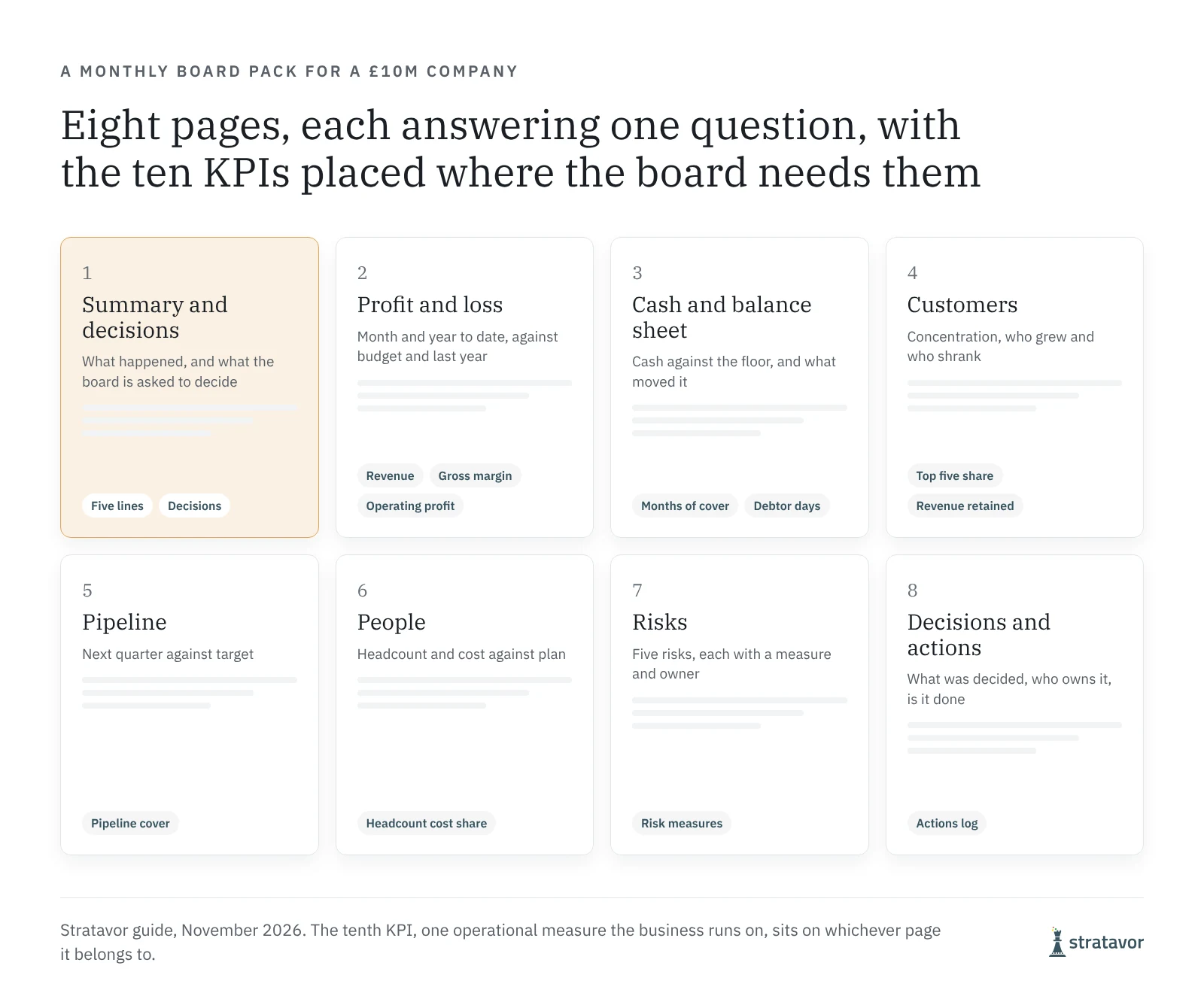
- Summary and decisions. Five lines on the month and the decisions the board is asked to make, before any statement. If a director reads one page, it is this one.
- Profit and loss. Month and year to date, against budget and last year, with commentary on every variance above your threshold. At £10m a year, a threshold of £10,000 or 5% for the month keeps the commentary to what matters.
- Cash and the balance sheet. Cash at the month end against the floor you set, what moved it, months of cover, and debtors and creditors.
- Customers. Top customers, concentration, who grew and who shrank, and debtor days by customer where it matters.
- Pipeline. Pipeline against the next quarter's target, what closed and what slipped.
- People. Headcount against plan, cost as a share of revenue, open roles and leavers.
- Risks. The five risks that would move the numbers most, each with a measure and an owner. Our guide to building a risk register sets out a one-page version.
- Decisions and actions log. What the board decided last time, who owns it and whether it is done.
The ten KPIs, with formulas
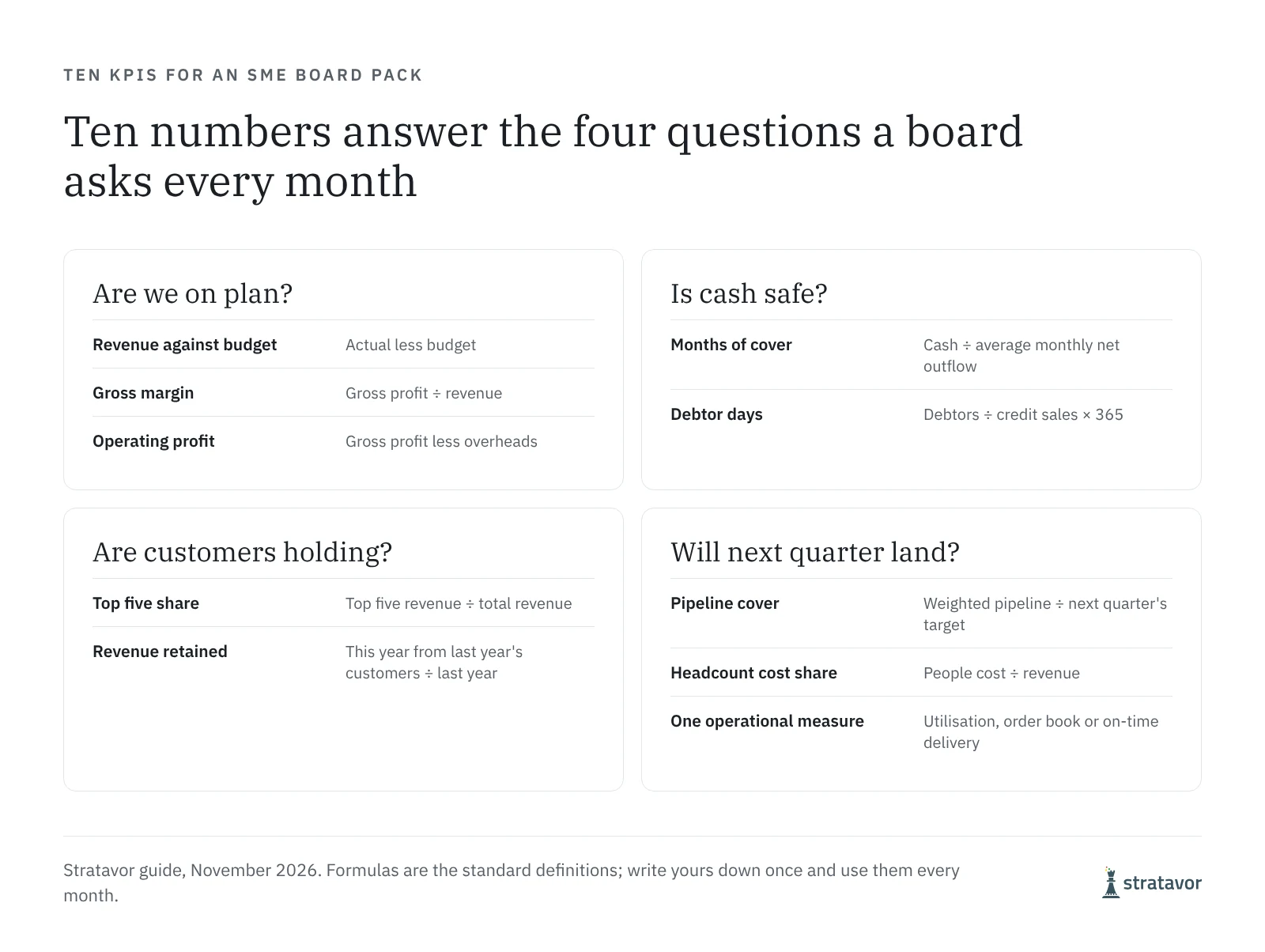
| KPI | Formula | Why the board needs it |
|---|---|---|
| Revenue against budget | Actual revenue less budget, month and year to date | The first question at every meeting |
| Gross margin | Gross profit divided by revenue | Shows pricing and delivery cost before overheads |
| Operating profit | Gross profit less overheads | What the business earns from trading |
| Cash and months of cover | Cash at bank; cash divided by average monthly net outflow | How long the business can absorb a bad run |
| Debtor days | Trade debtors divided by credit sales, times 365 | How fast customers pay, against your terms |
| Top five customers' share | Revenue from the five largest customers divided by total revenue | Concentration risk in one number |
| Revenue retained | This year's revenue from last year's customers divided by last year's revenue from them | Whether the customer base is growing or leaking |
| Pipeline cover | Weighted pipeline for next quarter divided by next quarter's target | Whether next quarter is likely to land |
| Headcount cost share | Total people cost divided by revenue | The largest cost line in most £10m businesses |
| One operational measure | Utilisation, order book, on-time delivery or similar | The number the business actually runs on |
Our free calculators work out three of these from your own figures: debtor days, customer concentration and cash runway. Our KPI selection guide helps choose the operational measure.
What to leave out
- Every account line. The detailed trial balance belongs in an appendix or nowhere. The board needs the movements that matter.
- Charts without a sentence. Every chart should carry one line saying what it shows and why it matters.
- Variances below the threshold. Commenting on every small movement hides the large ones.
- Last month's commentary with new numbers. If the paragraph could be pasted into any month, it is not commentary.
Commentary is what makes it a board pack
The same statements go to the bank, the auditors and the tax adviser. What makes a pack a board pack is the explanation: what changed, why, what it means and what to decide. Four sentences per material variance is enough. Our board commentary template sets out the standard, and our guide to writing variance commentary shows it worked through.
Where Stratavor fits
Stratavor connects read-only to Xero, QuickBooks Online, Sage, NetSuite and Deltek Vantagepoint, with HubSpot for customer and pipeline context. It computes the KPIs above from the ledger in code, every month, and writes the commentary on each material movement, naming its cause and framing the board's question. It covers customers, risk and cash as well as the profit and loss, for single companies and across groups. See the reports or book a demo.
Frequently asked questions
What should a monthly board pack include?
A one-page summary with the decisions asked for, the profit and loss against budget and last year with commentary, cash and the balance sheet, customers, the pipeline, people, risks, and a decisions and actions log. About eight pages for a £10m company.
Which KPIs belong in an SME board pack?
Revenue against budget, gross margin, operating profit, cash and months of cover, debtor days, the top five customers' share of revenue, revenue retained from last year's customers, pipeline cover, headcount cost as a share of revenue, and one operational measure the business runs on.
How long should a board pack be?
For a £10m business, about eight pages plus appendices. If directors are not reading it before the meeting, it is too long.
How often should an SME board pack be produced?
Monthly for the finance pages, even if the board meets quarterly. A monthly pack catches a problem two months earlier.
What is a good materiality threshold for board commentary?
Set one in money and one in percentage, and comment when either is crossed. For a £10m business, £10,000 or 5% for the month is a common starting point.
Can software produce the board pack automatically?
Software can compute the figures and draft the commentary. Stratavor computes every figure from the ledger in code and writes commentary that names the cause of each material movement; the finance lead reviews it and adds the judgement.
The Stratavor digest
One email a month. Worth opening.
Decoded films on real companies' results, short films on how businesses make and lose money, and guides on customers, competitors, risk, cash and the board pack. No sales emails.
By subscribing you agree to receive the monthly Stratavor digest. Unsubscribe at any time from any email. Privacy policy.